
Complete list of book reviews on the AIMS website
AIMS Journal, 2023, Vol 35, No 3
Union Street, by Pat Barker
[Birth in the context of lifecourse/testing lives, a historical fictional primer]
|
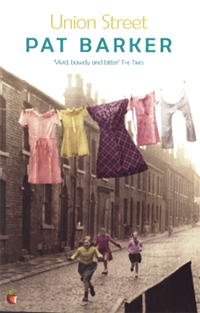
Union Street By Pat Barker Published by Virago, 1982 ISBN 9780860682837 272 pages Publisher’s recommended price £9.99 Buy this book on Amazon |
 |
Reviewed for AIMS by Jo Dagustun
As luck would have it, my second read this summer offered an unexpected insight into birth as it might have been experienced by working class women in the North East of England in the late 1970s/early 1980s. (I say might, but just a small amount of contextual reading about Pat Barker’s own family life suggests that this book is likely to be as much reconstructed memoir as novel.) And I felt this was too good not to share with fellow AIMS Journal readers.
Union Street, by historical novelist Pat Barker, published in 1982 by Virago Books, is a linked collection of seven stories, each focussed on one woman's story over a period of a few months. These women’s lives are set against a background of an economic downturn and industrial restructuring, and deeply affected by poverty, violence and sexual oppression.
But this isn’t just a collection of stories about seven different women. Barker’s arrangement of the stories by ‘lifecourse’ brings some welcome and helpful order to the reader, starting with a story about a young girl and ending with a story about a dying woman haunted by the spectre of the Workhouse;[1] these two characters also neatly meet each other in the closing pages, which emphasises well the circle of life. Also, there are good links between the stories, as main characters crop up in each other’s stories: this allows insight into the strengths and weaknesses of the fictionalised community networks depicted.
Within the stories, there are many gynaecological or maternity episodes as key themes. We read about women giving birth and preparing for death, girls surviving rape and women surviving backstreet abortion, a woman’s unexpected pregnancy (and plans for marriage as a consequence), one woman’s experience of pelvic organ prolapse, talk about periods, lives of prostitution and experiences of marital bereavement. In the way that she organises this book, Pat Barker’s work illustrates well the current call to see women’s health issues not as isolated episodes, but in terms of the lifecourse: social, economic, physical and emotional. Men, children and other relatives feature in the stories too, but the focus is very much on the women. Together, these stories offer a hugely depressing but compelling insight into the embodied reality of women’s lives in that place and during that time, although much sadly still resonates today.
For those focused on maternity, there are just short of 18 pages detailing one woman’s \experience of a single labour, birth and early postnatal period. Is this thought-provoking text ever used for teaching purposes with students of midwifery and obstetrics, I wonder? The level of detail it contains is exquisite. If you have time to read any of this book, please read this!
It’s a real treat to come across a first novel from such an exceptionally talented author, who went on to write many more acclaimed novels. It’s a hard read, with themes that some might say deserve a trigger warning, but I’d recommend it to anyone interested in reflecting on the sexed and embodied nature of women’s lives in general and on the history of the UK maternity services specifically. From an AIMS perspective, it brings home why work to improve the maternity services needs to be grounded in an understanding of the importance of offering all women, whatever their personal situation, an excellent standard of care, ideally underpinned by a relational model of care (or midwifery continuity of carer)[2]. It’s worth noting that a midwife’s care could be the first really powerful experience that some women get, for example, of a trusting loving relationship, relational humanised care that demonstrates - through words and deeds and through simply showing up and being there - that they are important, that they matter, that they deserve respect. For every woman blessed with such care - whose influence will extend far beyond that pregnancy and birth - that validation is truly worth its weight in gold.
I’ve yet to read an old green spined classic from the Virago publishing house that didn’t come up trumps. So look out for that Virago spine - complete with the half-eaten apple logo - when you’re next at your local bookswap or, even better, search this title out and devour. The forbidden fruit from this ’feminist publisher of outstanding books for all readers’ is still as tasty as ever!
See a possible cover image here: Union Street | Virago Bookshop
[1] Editor’s note: From Victorian times until the mid 20th century, the workhouse provided shelter and work for those unable to fend for themselves. https://www.historic-uk.com/HistoryUK/HistoryofBritain/Victorian-Workhouse/
[2] AIMS (2021) AIMS Position Paper Continuity of Carer https://www.aims.org.uk/assets/media/726/aims-position-paper-continuity-of-carer.pdf
The AIMS Journal spearheads discussions about change and development in the maternity services..
AIMS Journal articles on the website go back to 1960, offering an important historical record of maternity issues over the past 60 years. Please check the date of the article because the situation that it discusses may have changed since it was published. We are also very aware that the language used in many articles may not be the language that AIMS would use today.
To contact the editors, please email: journal@aims.org.uk
We make the AIMS Journal freely available so that as many people as possible can benefit from the articles. If you found this article interesting please consider supporting us by becoming an AIMS member or making a donation. We are a small charity that accepts no commercial sponsorship, in order to preserve our reputation for providing impartial, evidence-based information.
AIMS supports all maternity service users to navigate the system as it exists, and campaigns for a system which truly meets the needs of all.