
AIMS Journal, 2025, Vol 37, No 3
By Alex Smith
An increasing number of new mothers begin breastfeeding following a long drawn-out process of induction of labour. Currently about one third of UK mothers are induced, a figure that is set to rise and a cause of great concern to many.
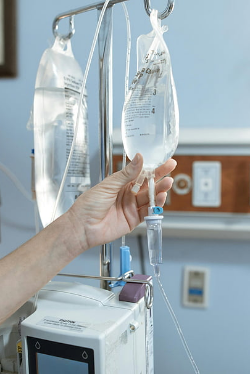
Over and above the repercussions of induction itself, a newly emerging worry is about the effect on women of having been on an IV drip for some length of time before the birth. This is likely to have been the case for anyone being induced with syntocinon. Author and childbirth activist Henci Goer, explains some of the unintended effects of IV fluids in this short video.
The particular issue that I want to flag up here is the way in which IV fluids given to the mother can ‘waterlog’ the baby, overinflating the baby’s natural birthweight. This excess water is ‘peed away’ by the baby over the first 24-48 hours.1
Most babies tend to lose a few ounces in the first few days after the birth and when this totals an amount equal to or less than 10% of their birth weight, no one is worried. However, the extra ounces of water can bring the apparent total weight-loss to over the 10% allowance and this is when the problem begins. Very few health practitioners are aware of the effect of IV fluids in this respect. When the weight loss is over 10% the mother will gain the impression that her breastmilk is insufficient. She will be encouraged to continue breastfeeding but may be advised to ‘triple feed’ her baby - breastfeed, pump and give expressed milk, and top up with formula. NICE guidance and many hospital guidelines recognise that topping up (or supplementing) with formula increases the chance of early cessation of breastfeeding, but individual practitioners are often more focused on the weight gain.
Health practitioners may have no idea of the anxiety and torment caused when breastfeeding support fails in this way. The mother is already feeling wrung out and possibly very disappointed by the birth experience, and this is now compounded by breastfeeding grief.
Of course it is important to know that a baby is feeding well, so what to do?
EASY - If the mother has received IV fluids during labour, weigh the newborn after the first 24 hours. This will give a much more accurate measurement on which to base the baby's weight gain.

Author Bio: As a childbirth educator, Alex was alerted to this issue having listened to a growing number of mothers reporting that their baby had lost too much weight in the first three days after birth.
1 Giudicelli M, Hassler M, Blanc J, Zakarian C, Tosello B. Influence of intrapartum maternal fluids on weight loss in breastfed newborns. J Matern Fetal Neonatal Med. 2022 Feb;35(4):692-698. doi: 10.1080/14767058.2020.1731453. Epub 2020 Feb 20. PMID: 32079436.
Please feel free to download and share a pdf of this article. If you wish to use AIMS copyright material please see aims.org.uk/general/aims-copyright
If you found this article helpful please consider becoming an AIMS member or making a donation to support our work. We are a small charity that accepts no commercial sponsorship, in order to preserve our reputation for providing impartial, evidence-based information.
AIMS supports all maternity service users to navigate the system as it exists, and campaigns for a system which truly meets the needs of all.