
AIMS Journal, 2025, Vol 37, No 2
By Jane Furness
In my experience in Northern Ireland, physiology is not on the radar of those providing maternity care to pregnant women living with diabetes, particularly Type 1. It’s all about numbers, risk, statistics, percentages, bloodwork, scans, inductions, C-sections and general ‘danger’. I always felt like a ‘Type 1 diabetic who’s pregnant’ compared to ‘a pregnant woman living with Type 1 Diabetes’ – do you hear the difference? From my first consultant appointment at 7 weeks in my first pregnancy, where I was told before my notes were even opened; “…don’t worry, we won’t let you go past 39 weeks”, I knew I could do better and actually did need to worry! By the time the second trimester had quickly-but-not-so-quickly rolled around, I was on the path to battling for a supported birth at home to protect the physiological birth that I wanted, deserved, and knew I could do. (AIMS Journal, 2024, Vol 36, No 2)
Despite a home birth transfer and birth with the ‘help’ of instruments for my eldest, I didn’t hesitate to go straight back onto the home birth path for my second baby. I wasn’t put off and I was absolutely even more determined (if possible) to have it. Since embarking on the parenthood journey, and particularly this very ‘abnormal’ one, I was made to feel reckless, difficult, and stupid for my choice to have a baby outside the ‘safety’ of guidelines. But as I often tell people, this isn’t a decision someone in my position makes lightly; it isn’t on a whim or impulse, it isn’t done without all-consuming thoughts about it, and it’s not to impress anyone. It’s a decision made to protect the short and long-term physical, mental and emotional parts of mummy, baby, and close family in today’s world where physiological birth is endangered. My reasons generally did not change between pregnancies;
In my most recent pregnancy in 2024, I picked and chose the parts of maternity care I wanted to have. I filled out the online self-referral in the early weeks and selected ‘Birth at Home’, but was already in touch with the lead midwife of that team (the only dedicated home birth team in Northern Ireland) and let her know. She supported my first labour before the transfer, and went above and beyond for us in this pregnancy to see our wishes granted. I accepted 12 and 20-week scans to check the baby, but no growth scans (unheard of for a diabetic!). I requested a few scans to check the fluid, cord, and placenta. I cancelled alternate appointments because they felt pointless and challenging with a toddler every week or two. Sometimes I had family or homebirth midwife or doula support at the diabetes antenatal clinic. I declined clinic appointments after 35 weeks to avoid induction conversations and to focus on remaining calm during the final weeks, after which I had weekly/biweekly home visits from the Birth at Home team. I threw in a couple of Assessment Unit visits for good measure too to check on Baby’s movements and heart rate.
I was so sure this second birth would be sooner and much quicker than the first; I was bitterly disappointed. After five weeks of niggles and little pains, labour properly began with a gush of waters breaking at 2pm whilst napping with my toddler in bed at 40 weeks and 5 days. I immediately texted our midwife with excitement and will never forget how my heart was racing. I regretted texting her so soon though, as I realised I was now on an imaginary clock. But not to worry, contractions started within the hour after my husband got home from work. We carried on with our day doing some chores and I made dinner. It felt right to text our doula who came soon after to keep us company and help set up the pool. I was absolutely desperate for a dramatically quick labour but Baby had other ideas. My toddler went to bed at her normal time with her daddy so I had a few hours with our doula before we decided to get in touch with the midwives around 10pm as I really wanted to hear Baby's heartbeat. The contractions felt close and intense, and I was feeling unsure of Baby's movements so reassurance was necessary to keep me in the right headspace. Luckily, Baby was absolutely fine! Our doula, who was the same doula from our eldest’s birth, has magical hands; her hip squeezes through contractions and back massages as I lay over the ball were heavenly - amazing pain relief. My husband went to bed for a while as my situation wasn’t changing and he was needing sleep coming up to the 24-hours-awake mark. I laboured in a very specific place in our living room and cannot explain why I naturally gravitated to this spot! I wanted to stand at the door through contractions and generally made a lot of noise, something that surprised me when I first gave birth. I couldn’t sit down or get into the pool because my body relaxed and slowed down the progress every time, and I really wanted to keep momentum going. So, I stood firmly and spent a few hours on this plateau. The midwife really tried encouraging me to lie down and have a doze but this seemed absolutely impossible through these very intense contractions. But I did what I don’t normally do and obeyed. It was hell! The contractions were much more painful lying down and I was so uncomfortable. I was adamant I wasn’t sleeping at all but the midwives were listening and said I was managing to sleep for several minutes between each surge, and I was lying there for over an hour and a half! And it worked – when I eventually got up, there was a big shift and progress was accelerating. I felt the need for the entonox to snip off the peak of the surges now and I wanted to get back into the water for comfort. I started making bigger and louder noises then BANG; transition. I cried and sobbed so unexpectedly. It was uncontrollable but I took comfort in the fact that Baby was nearly here! Not long after, my husband and daughter woke at 6am; he was in charge of managing my blood sugars (which barely needed touching) and she was responsible for simply playing and being nice company! Around 8am, my body felt ready to push and that familiar, overpowering sensation brought me to my hands and knees. The gas was useless now so I used every ounce of energy to roar Baby out (not before a short-lived panic from me that Baby had stopped moving down and that she was stuck). Apparently, it was about an hour of pushing but it felt endless. The physical power it took was unbelievable, and my toddler said I sounded like a dinosaur! As with her, the cord was too short for Baby to lie on my chest with the placenta yet to be born, and I felt so weak from the effort that I wasn’t confident in holding Baby. I was in so much shock at what my body had just done I just swore repeatedly. I eventually managed to turn and lie in the pool with Baby halfway up my torso, and then was reminded I could now discover Baby's sex. It was dark with the curtains closed and I had no glasses on but I held them up, squinted, and shouted ‘I think she’s a girl but I can’t see properly!’ I looked up at everyone around the pool looking down at me; all except my daughter crying their eyes out and I couldn’t understand why. It’s one image I will never forget and always find hilarious. The placenta was making me incredibly uncomfortable; I was planning on Baby staying connected until she was born; a kind of lotus birth, but the discomfort was unbearable. So the cord was cut earlier than planned and baby girl number two was handed to her daddy for cuddles whilst I waddled to the toilet to get this damn placenta out. I had a short phase of struggling to breathe and described it as feeling winded. In hindsight, I think it was the huge shift in my diaphragm and the exertion on my abdominal muscles that was a big shock to my body. The next big shock was the fact I just pushed a 9lb baby out and was just sitting on my sofa with my little family! Cuddles and feeding was next on the agenda, followed by a few stitches for a hefty second-degree tear (thank you P for not sending me to hospital!). The closing ceremony of our birth at home was a birthday cake and singing Happy Birthday to our new baby girl.

I find most home birth stories, especially for second or subsequent timers, describe a feeling of transformation, restoration after a traumatic first birth, or life-changing. I felt virtually nothing. I couldn’t believe all those tears from everyone, whilst I metaphorically shrugged my shoulders and said ‘so what?’. I think this is because I spent the last three years working tirelessly for my babies to be born at home and when I work hard for something, I EXPECT it’s going to be a success (spot the perfectionist and over-achiever). THIS is how birth should and can be, and it shouldn’t be a surprise that being in the right place (wherever that is), surrounded by the right people, and confident with the right education and knowledge, gives us the greatest chance of getting out the other side of pregnancy physically and mentally intact. I mean, I kind of wished I felt a little bit more emotional about my daughter being born but I was much more emotionally charged by way of sticking my two fingers up and saying ‘I told you!’ at every doctor and midwife who told me I couldn’t and wouldn’t be allowed to do it this way. The homebirth midwives shared this sentiment as they went straight onto their laptop, giddy to send a ‘breaking news’ email to every member of maternity staff in the trust. This kind of moral support validated my belief in myself as I was always made to feel irresponsible, and like I knew nothing about myself. I was so glad my 2-year-old witnessed and contributed to her sister being born, and saw ‘normal’ birth. She was fantastic and took it all in her stride (we can thank the book ‘Hello Baby’ for helping with that in the months leading up to this!). After discovering Baby's weight, I was incredibly glad I chose to decline growth scans; the comments made by the obstetrician and midwives after my first 7lb 4oz baby that “if she was any bigger she would never have come out” (as I lay on a theatre bed with my legs in stirrups and an episiotomy) have never left me and would have been ringing in my ears at every measurement if I had taken them. Keen eyes may have also spotted that I didn’t have a single cervical examination during this birth; a choice I made clear and was respected.
I came away from this birth feeling content, proud, and very, very sure that our family was complete. I’ve carried no trauma from it, only pure disbelief and amazement that my body did it all itself (and maybe a bit of embarrassment that I sounded like a dinosaur!). 
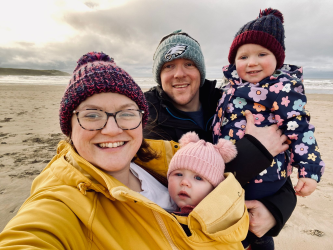
Author Bio: Jane, Andy, Penny, new baby daughter Maisie live in County Tyrone. Maisie absolutely adores her older sister and Penny still talks about how she was born!
The AIMS Journal spearheads discussions about change and development in the maternity services.
AIMS Journal articles on the website go back to 1960, offering an important historical record of maternity issues over the past 60 years. Please check the date of the article because the situation that it discusses may have changed since it was published. We are also very aware that the language used in many articles may not be the language that AIMS would use today.
To contact the editors, please email: journal@aims.org.uk
We make the AIMS Journal freely available so that as many people as possible can benefit from the articles. If you found this article interesting please consider supporting us by becoming an AIMS member or making a donation. We are a small charity that accepts no commercial sponsorship, in order to preserve our reputation for providing impartial, evidence-based information.
AIMS supports all maternity service users to navigate the system as it exists, and campaigns for a system which truly meets the needs of all.