
AIMS Journal, 2026, Vol 38, No 3
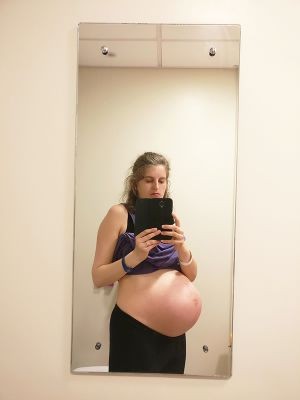
Jocelyn at the hospital 5 hours before her baby was born.
By Jocelyn Allen
It was June 2020 in Liverpool, England. The country was in its first Covid-19 lockdown and I was almost 38 weeks pregnant with my first child, sure that I’d be a 41-weeker. At the time we didn’t know what sex our baby was due to cancelled scans and the baby not ‘presenting’, but it ended up being a girl who I’ll refer to as B.
We’d decided on a homebirth, which my husband Tiago was more comfortable agreeing to after we’d done an online hypnobirthing course. I had an emergency bag packed for the hospital, sure that it wouldn’t be used, but it was there just in case in the corridor.
Around one in the morning I suddenly woke up with the urge to go to the toilet and the next thing I knew my waters broke. Unexpected! We didn’t want to bother the midwife due to the time, so we called the hospital and they said to come in for CTG monitoring.
So off we went to hospital. Quite normal usually, but not for me; I hadn’t been in the car for three months, let alone another building. Tiago was told to stay in the car park where he set up the baby car seat, while I sat in a waiting room with my mask on. They called me in and I sent audio recordings to my husband of B’s heartbeat. At some point the lady felt my bump and said that she thought B was breech. A couple or so days before when my midwife had come over for a check-up B had been in the ‘correct’ position, but the breech presentation was confirmed and I was told I wouldn’t be allowed to leave.1 However, someone would be in around 9am who could potentially turn B and if that procedure was successful then I could go home. I was moved onto a ward with other women (it felt strange being so close to strangers) and around 8am I was hooked up to more monitors but my surges calmed down. After shuffling off to another room and being examined, I was told that there was no fluid left to turn the baby.
They tried to push me to have a c-section, but I said I wanted to try for a vaginal delivery. This conversation was had a few times with various people, but I repeated my request. I was then told that I had until 6pm, since B would need to be born that day and that it was better for the caesarean to be planned for early evening rather than late at night. I texted Tiago that ‘baby is on a timer’. I didn’t want the stress of this ‘deadline’ to stop my surges, so I closed the curtains around my bed, put in my earphones and danced through the waves while Tiago was at home cleaning our flat.
The surges were getting stronger and, as it was a couple of hours since I had been found to be 3cm dilated, I was moved to a delivery suite where Tiago could join me. A student midwife moved across with me which I was happy about as she was kind, keen to see a vaginal breech birth, and I felt that she was on my side.
The surges were getting stronger still and I just wanted to sit on the toilet, which concerned the main midwife as she was worried I’d give birth there. I’d wanted a water birth, but I wasn’t allowed because of B being breech. So, I was moved to the bed, which was apparently new and had a toilet-like feature built into it, which at least made me feel better about the situation. At some point a cannula was put into my wrist, which I was told was for pain relief but I also understood it was for if an emergency occurred. I undressed my lower half as it just felt like a hindrance, and I stopped caring about how I looked to everyone else. The surges were now stronger and I turned and gripped onto the back of the bed while breathing through them. At some point Tiago had arrived, and he and the student midwife put a rented TENS machine (which had arrived by post the day before) on my back. It was good in the beginning, but then I found it annoying so they turned it off. The room felt boiling hot and there were no available fans so Tiago just wafted me with a piece of paper.
The small team that assembled kept telling me not to push but I couldn't help it, though after a while I was examined and they said it was now fine for me to. So I started to push and one midwife began to coach me – telling me to keep pushing, breathe, then push again once another surge appeared; I told her to keep doing it. I’d get leg cramps first and then the surge would arrive with force.
After a while I was asked to turn around. There were more people in the room than I had thought – I looked at them and the resuscitation machine (since they were worried about B’s head getting stuck), then looked away to ‘get in the zone’.
Not long after, I could see a little foot hanging out, but then there wasn’t much progress. They asked if they could do an episiotomy. I said yes since, if it helped B come out there and then, it seemed like a good option.
I got bored of the surges and the pushing, I hoped that every push would be the last one. I felt quite high from the breathing though and finally she came out at around 4:30pm (two hours after they’d put the cannula in). It was a girl, six pounds nine ounces. They asked to give me an injection to help with the placenta delivery and blood loss, and I said okay. Then they stitched me back up, which seemed to take ages and was more painful than the birth.
It was all so surreal. I’d grown this baby inside of me and now I was having a long skin to skin session with her. The student midwife tried to help me breastfeed for two hours, and then we were alone as a family. Tiago had around two hours of skin to skin, and then someone came to say that B and I were being moved to a ward and Tiago would need to leave. I wouldn’t see him again for four days. It was tough.
At the time I felt like I’d had a very positive experience, even though some of my main birth preferences went out of the window. I felt like I’d had a plan for different scenarios, but I hadn’t considered my baby being breech. However, the fact that I’d stood my ground and asked to try vaginally made me feel good about it. Yes, they’d given me a deadline, but I knew if I let that stress me out then labour would have probably stopped and there may have been more interventions. I had randomly seen a video of someone giving birth to a breech baby on Instagram, so I knew it was possible.
Looking back now, I think if they’d let me get into a better position then the episiotomy may not have been necessary. I was slouched back against the bed and not in an upright position; in comparison my second child was born in a birthing pool while I squatted. Perhaps if I’d been allowed to squat or at least been in a position where gravity could have aided B’s birth more, then perhaps less intervention would have been needed. However, I am aware that they were concerned about B’s head getting stuck and they wanted a clearer view of the situation. Maybe we could have met somewhere in the middle somehow? I’ll always be grateful to those who assisted me with the birth though.
Author Bio: Jocelyn Allen is an artist who mainly works with photography, writing, video and dance. She predominantly uses herself within her personal work to explore the themes of self-confidence, hiding and revealing, body image, and motherhood.
1 Editor’s note: For the reader’s information, a hospital cannot legally prevent a mother from leaving if she wants to.
Please feel free to download and share a pdf of this article. If you wish to use AIMS copyright material please see aims.org.uk/general/aims-copyright
If you found this article helpful please consider becoming an AIMS member or making a donation to support our work. We are a small charity that accepts no commercial sponsorship, in order to preserve our reputation for providing impartial, evidence-based information.
AIMS supports all maternity service users to navigate the system as it exists, and campaigns for a system which truly meets the needs of all.