
AIMS Journal, 2026, Vol 38, No 3
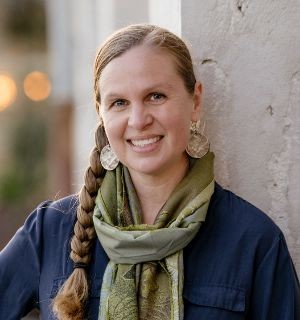
By Rixa Freeze, PhD
For a long time, breech birth lived in my mind as a question I could not quite put down. It was never just a clinical topic to me, never merely a matter of fetal position or management options. It felt more like a door into something larger: the way maternity care decides what is normal, what is risky, what is worth learning, and what is simply allowed to fade away. The more I thought about breech, the more I felt that it exposed something fundamental about birth itself — not only how babies are born, but how knowledge is kept, lost, and recovered.
I did not begin my career expecting to spend so much of my life on breech. My background was in American Studies with emphasis on maternity care and childbirth, and that gave me a way of looking at systems, stories, and institutions through multiple lenses rather than taking any one narrative for granted. I spent my PhD years being immersed in the worlds of midwifery, home birth, and unassisted birth and ultimately wrote my dissertation about why women in North America choose unassisted birth. I also apprenticed with two home birth midwives and attended births as a doula.
During those years, I was introduced to breech via Jennifer Block’s book Pushed, an exposé of the American maternity care system. In the book, she wrote about attending the first International Breech Conference in Vancouver, BC, Canada in 2006. I was fascinated by the collaboration between home birth midwives and hospital-based obstetricians, all centered around upright or physiological breech birth–a “new” discovery within the obstetrical world but something as old as time within the home birth midwifery tradition. I was so used to seeing home birth midwifery and hospital-based obstetrics as opposites in a battle that it was refreshing to read about a space where sharing knowledge took precedence over ideological divides.
Breech seemed to sit exactly at the point where evidence, culture, fear, and professional habit all meet. I understood VBB (vaginal breech birth) as the ultimate litmus test for maternal autonomy, since it is so taboo and transgressive in mainstream maternity care to do anything but mandate a cesarean section for every breech presentation. Those midwives and physicians still supporting vaginal breech birth were often the ones also championing VBAC, twin vaginal birth, water birth, and choice of birth place and provider.
Breech also became personal to me during my second pregnancy, when my son was discovered to be breech via palpation around 34 weeks. Intellectually, I knew it was a bit early to be worrying about it–but still I worried! I drove myself mad trying all sorts of things to get him to move.
My birth options were extremely limited. My midwife assured me that she would never abandon me and that she would attend my birth no matter what. However, while she had a good amount of breech skills training, she had not attended a large number of VBBs. There were zero hospital options anywhere in my area—and I didn’t want a hospital birth anyway! We looked into driving down to The Farm in Tennessee1, but as it was a 10-hour drive, I doubted I would make it. My first labor start to finish was just 10 hours and I knew my next one would be shorter.
My son ultimately turned on his own by the next prenatal visit. I wish I hadn’t tried to “fix” him or to treat him like a problem. But the lack of options that I faced was terrifying.
After finishing my PhD, birthing and breastfeeding four babies, and starting to teach at a small liberal arts college, my fascination with breech continued. Once my youngest started public school in France at age 3, I found myself with an amazing gift: time. Hours of uninterrupted time every day where I could explore my academic interests. I decided to start specializing in breech, and my first step was to read everything about breech birth that existed. (I was a bit naive in how ambitious this was!) For about a year, I spent day after day systematically working my way through PubMed from the 1800s to the present, reading and cataloguing every article.
From there, I began to give lectures on various breech-related topics. This evolved into teaching skills workshops in conjunction with a local experienced provider: me providing the academic and didactic information, them providing the hands-on skills.
The turning point came in 2017, when I traveled to Russia to give several lectures on breech. I saw that knowledge about breech was simply not moving freely across countries, languages, and professional silos. The audiences kept asking me, “What is this Term Breech Trial? We have never heard of it.” 2
That was the moment I understood that breech knowledge had borders. Those borders were geographic, of course, but also linguistic, professional, and cultural. Knowledge could be abundant in one place and invisible in another simply because there was no bridge between them. That realisation was sobering, but also hopeful. If information could be blocked, then information could also be shared. If skills had been lost in one system, perhaps they could be rebuilt.
That was the beginning of Breech Without Borders (BWB); I just didn’t realise it at the time! I remember thinking in St. Petersburg, “Someone needs to start an organization dedicated to helping breech knowledge cross borders.”
A year later, that person became me…because no one else was doing it. I founded Breech Without Borders in 2018 as a nonprofit dedicated to breech training, education, and advocacy. The name was not symbolic fluff; it described the problem exactly. I wanted breech information to move more freely between research and practice, between midwives and obstetricians, between experienced birth attendants and novices, between academic ideas and widespread understanding.
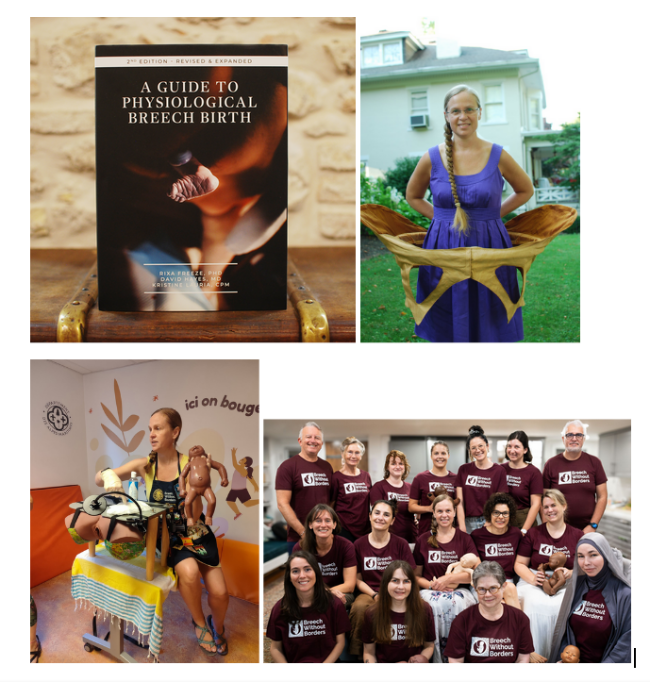
In just 8 years, we have grown into an international organization with instructors from multiple continents teaching in university hospitals, private clinics, home birth collectives, refugee camps, and war zones. Our instructors are as diverse as our students: we have obstetricians, MFMs (Maternal-Fetal Medicine Specialists), certified/registered midwives, unregistered midwives, and traditional birth attendants, all teaching the same skills and approaching breech with the same philosophy.
BWB is not a birth-attending service. It is an educational and advocacy organization designed to make breech expertise more available, more visible, and more practical for the people who need it most. We teach, we publish, we connect, and we support. We work to make sure that parents can find information that is not frightening, but useful; and that clinicians can find learning that is not only theoretical, but hands-on and clinically grounded.
One of the most important things we do is teach the physiology and mechanics of breech birth. In our training, we walk through the predictable mechanisms of upright breech birth and the signs that birth is proceeding normally versus the signs that something is becoming obstructed. That kind of teaching matters because breech birth becomes much less mysterious when you can see what the baby is doing and understand why. A clinician who understands those movements is no longer relying on panic or guesswork. They can observe, interpret, and intervene with a steady hand if needed.
The textbook A Guide to Physiological Breech Birth grew out of the same impulse to cross borders. Originally the book was written because Amish midwives who could not access the internet wanted a way to learn from us. This book allowed us to gather the evidence, clinical wisdom, and visual teaching into one place so that breech knowledge would not remain scattered or hidden. The book brings together research on outcomes, practical guidance on maneuvers, and detailed explanations of how physiological breech birth unfolds, especially in upright positions. We also included parent stories and guest interludes from clinicians around the world, plus thousands of pictures in a visually appealing layout. I ordered the chapters like the rhythms of labor: the clinically intensive chapters (contractions) are broken up by parent stories and guest interludes (breaks between contractions). Our textbook pushes the boundaries of what textbooks can look like and how they can function–they can be beautiful and emotionally moving as well as clinically useful.
I am often asked what I would say to clinicians who feel they have missed the boat on breech. My answer is simple: you have not. It is never too late to re-skill. In fact, that is one of the most hopeful things about this work. Breech skills do not belong to a vanished past. They can be taught. They can be practiced. They can be reintroduced into modern maternity care in a way that respects both evidence and the realities of contemporary practice.
We are also trying to make breech education more accessible in several ways: through supporting a generous scholarship program, translating our courses into multiple languages, and developing low-cost ways to learn and practice. A favourite ongoing project is our DIY simulator; the BWB community has been turning silicone sex dolls into inexpensive DIY obstetric simulators. An obstetrician colleague and BWB instructor-in-training is working on a DIY 3D printed ECV3 simulator. Who knows what the next BWB community member will invent?
Parents need better information too, especially when they discover late in pregnancy that their baby is breech and are suddenly facing pressure, fear, and very narrow options. I am contacted by 1-2 parents every day seeking help finding a provider, usually at the very end of their pregnancies. Through our educational resources, talks, and publicly available materials, we try to help families understand that breech is not the end of the conversation. It is the beginning of a more nuanced one. Families deserve to know that there are different approaches, that risk is not the same as certainty, and that the skill of the provider matters enormously in shaping outcomes.
That is why I spend so much time speaking on podcasts and interviews. In those conversations, I keep returning to the same core message: breech should be discussed with facts rather than fear. I talk about what a breech baby is, what the actual risks are, what options families may have, and what the evidence says about vaginal breech birth compared with cesarean. I also try to make visible something that can get lost in standard medical messaging: a cesarean is not a neutral default or risk-free option. It alters the experience of birth, and it changes future reproductive options as well.
For me, the personal and the professional have never been fully separate in this work. The reason I care so deeply about breech is not only that it is a fascinating clinical topic, though it is. It is also that breech exposes how maternity systems think about autonomy, expertise, and the value of keeping options open. When a system allows breech skills to disappear, it has not just lost a technique, it shrinks the range of possible care options and does not ‘allow’ women to use their own vaginas It prevents families from choosing the birth that best fits their values and circumstances. It also makes it harder for clinicians to practice the full scope of their craft.
I think this is why Breech Without Borders has resonated with so many people. We are not trying to romanticise breech. We are trying to restore competence, widen choice, and keep knowledge alive. We host training, develop resources, support research, and create networks that allow people to find and share breech expertise. We want to make it easier for a midwife in one country to learn from an obstetrician in another, easier for a parent to find a trained provider, and easier for a hospital system to remember that skills can atrophy, but they can also be revived.
One of the most satisfying parts of this work is seeing curiosity replace fear. That change can happen quietly. A clinician comes to a workshop skeptical and leaves with a different posture, a more open mind, and a willingness to keep learning. A parent hears a breech talk and realises that their options are more nuanced than they were first told. A reader opens the textbook and understands breech as a physiological process rather than a category of disaster. Those moments may seem small, but they are how systems change. Not all at once, and not perfectly, but steadily.
One of my favourite teaching moments was when an OB, who was reluctantly dragged into a breech training, emerged at the end of the day, grinning. She announced, “I just unlearned 30 years of obstetrics!” Another favourite moment was, after training a highly experienced OB who had been doing breech birth his whole career, hearing him say, “I have been doing breech birth my whole life. But it wasn’t until I took your training that I finally understood what I was doing!” (He has since become a BWB instructor!)
If there is one message I hope people take from Breech Without Borders, it is that the loss of breech skill is not irreversible. We can teach it again. We can study it again. We can talk about it with honesty rather than panic. And we can do all of that while still respecting the complexity of birth and the seriousness of real risk. That balance — between caution and confidence, humility and skill — is what I have been trying to hold all along.
When I founded BWB, I think what I was really trying to do was make room for hope. Not false hope, and not the hope that breech is never risky, but the more durable hope that skill matters, training matters, and no one should have to accept ignorance as inevitable or cesareans as mandatory.
When I look back at the road that led to BWB, I do not see a single dramatic epiphany so much as a series of questions that refused to go away. Why had breech knowledge become so fragmented? Why were parents being offered so little? Why were so many clinicians being told, implicitly or explicitly, that they did not need to know how to do this well?
Breech Without Borders was my answer to those questions. It was my way of saying that the information exists, the skills exist, and the future does not have to be smaller than the past.
That is why I remain hopeful. Not because breech is easy, and not because every situation has a simple answer, but because I have seen what happens when people are given real information and real training. They get curious. They get brave. They learn.
And once that happens, the borders around breech begin to look less permanent than they once did.
Links:
Breech Without Borders: breechwithoutborders.org
Textbook: breechwithoutborders.org/guide/
DIY simulators: breechwithoutborders.org/diy-sim/
Publications (including Rixa’s PhD dissertation): breechwithoutborders.org/publications/
Upcoming breech trainings: breechwithoutborders.org/schedule/
Author Bio: Dr. Rixa Freeze has a PhD in American Studies from the University of Iowa. Her doctoral studies focused on the history of healthcare and medicine with specialization in pregnancy, childbirth, and maternity care. Her dissertation examined why women in North America choose unassisted home births. Dr. Freeze is the founder and president of Breech Without Borders, a nonprofit organisation dedicated to breech training, education, and advocacy. She also blogs at Stand and Deliver (rixarixab.blogspot.com).
1 Editor’s note: The Farm in Tennessee is a community that was established in 1971. It became famous worldwide for its midwifery practice led by Ina May Gaskin. https://thefarmmidwives.org/
2 Editor’s note: Sara Wickham offers a very simple introduction to the Term Breech Trial and explains why it was a flawed study. https://www.sarawickham.com/questions-and-answers/what-was-the-canadian-term-breech-trial/
3 Editor’s note: ECV stands for external cephalic version - a medical procedure used to turn a breech baby into a head-down position by applying gentle pressure to the mother's abdomen.
Please feel free to download and share a pdf of this article. If you wish to use AIMS copyright material please see aims.org.uk/general/aims-copyright
If you found this article helpful please consider becoming an AIMS member or making a donation to support our work. We are a small charity that accepts no commercial sponsorship, in order to preserve our reputation for providing impartial, evidence-based information.
AIMS supports all maternity service users to navigate the system as it exists, and campaigns for a system which truly meets the needs of all.