
AIMS Journal, 2026, Vol 38, No 1
By Naomi Glass
What is true birth preparation? Can there be too much or too little birth preparation? And can anything truly prepare us for what is about to unfold? In this article I will explore the answers to those questions through the thoughts of midwife, birth educator and artist, Pam England.
In her book, ‘Ancient map for modern birth’,1 England describes the need to approach birth preparation through the lens of both a ‘modern map’ and an ‘ancient map’. She also describes true birth preparation as being part conscious, for example, reading and researching, and part unconscious, which bubbles up in terms of limiting self-beliefs, habitual patterns, conditioning, cultural stories, past traumas. She says that good antenatal education supports you to dive safely but deeply into both of these parts.
THE MODERN AND THE ANCIENT MAPS OF BIRTH
Today’s antenatal educators are expected to cover the ‘modern map’ that England speaks of. This usually includes teaching about the anatomy and physiology of pregnancy and birth, available pain relief, positioning to support physiological birth, understanding the NHS and how to advocate for yourself/ your birth partner within that, writing a ‘Birth Preferences’ document, learning about UK birth rights, exploring the practicalities of what happens when birth doesn’t go to plan, caring for your baby and so on.
England writes:
“While the modern map of birth is accessible through common knowledge…the ancient map must be actively sought… The journey you are making is unique, but by following the ancient, universal map of the mythic journey of birth (the one that humans have been making for millennia), your childbearing year then links you to all mothers and parents who have come before you”. 2 (page 4)
England describes how the ancient map of birth is NOT a simplistic map to achieving a perfect birth or any other outcome. The modern natural birth movement often focuses on simply ‘trusting birth’ and ‘trusting your body’. Innate within this teaching, there is an implication that if we follow the right formula, then by rights we should be able to expect a straightforward physiological birth. I see this form of teaching as a totally understandable reaction to the often extremely traumatising interventionist approach of the modern medical model. Unfortunately, many women emerge from their births after this kind of ‘simplistic map’ form of antenatal education, feeling traumatised that they have failed because their births didn't go to plan.
When this happens, women often blame themselves. Limiting self-beliefs dominate how we tell our birth stories, and consequently, our life stories. This often translates into how we see ourselves as women and mothers. The binary story of good/bad, success/failure often ripples out into the rest of our lives, seeping into how we parent, into our relationships, our work, our health. The potentially devastating effects of teaching only from this simplistic map are untold.
So where is this ancient map of birth and what does it look like?
2 (page 5)
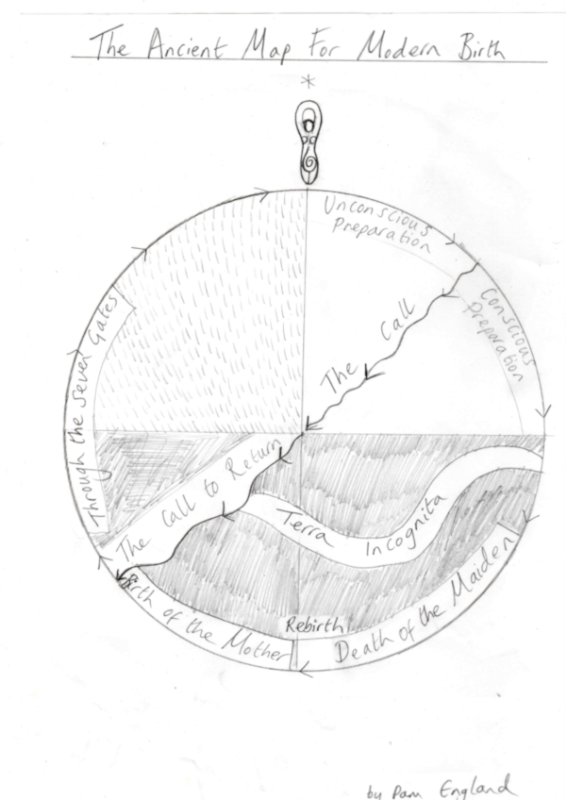
England teaches that the ancient map is designed to reassure us that whatever happens during our births, we are not lost. The ancient map shows us how true birth preparation involves journeying across countless inner thresholds, over unforeseen hurdles, beyond our edges and into unknown and unchartered territory (terra incognita). It shows us that the transition into parenthood is a true rite of passage.
The ancient map is illustrated by the ancient symbol of the labyrinth that has been used in birth preparation since ancient times. The labyrinth (unlike a maze) is designed for us to find our way to the middle (our calling/ our heart's desire/ our baby) and then back out again. If we just keep taking one step at a time along the path we will return, however changed as a person we may be by that point. By following the ancient map we learn that in order to give birth to this new part of our life and to give birth to our babies, “if you just keep going, you will find your way ‘home’ again.” Rather than simply being taught to ‘‘trust your body”, the ancient map helps you to see and believe instead that you can: “trust that you can meet whatever challenges come your way.” 2
BIRTH AS A MYTHIC JOURNEY
By following the ancient map of birth, the mythic journey of birth also becomes apparent; this archetypal story has been repeated for as long as humans have been able to tell and record stories. In order to face, encounter and return home from a rite of passage, an ordeal or adventure, all warriors (whether they be ‘birth warriors’ or ‘warriors of war’ off to slay dragons in order to save their people) have to:3
Prepare as best as they can for the unknown events ahead.
Step into the unknown, leave home and simply use everything that they have learnt throughout their lives in order to do their best at any given moment with what this ordeal or adventure may throw at and teach them.
Return home afterwards. The return journey takes time and involves the dawning awareness that they are a changed person (they have been reborn) and that they did their best.
THREE FORMS OF ‘KNOWING’ NEEDED FOR BIRTH
England also teaches that true birth preparation, requires us to tap into three forms of knowing;
Modern knowing - this involves being savvy about hospital and medical norms and how to give birth within or outside of this framework, including what cultural and social ‘norms’ are informing or affecting your decisions. Modern knowing is often based on a belief that the only truth is an objective one derived from logic. We tend to assume that medical recommendations arise purely from science, when often advice in the modern model comes from a variety of belief systems, including the need to be right or to avoid litigation, having limited perspective or knowledge of alternatives, or quite simply from fatigue or burnout. Thoughtful analysis of your specific situation is required to guide your decisions.
Intuitive knowing - Maternal instinct or intuition is in your gut and in your bones, not in your thinking mind. Modern culture has taught us not to trust or act on our intuition. Intuition is knowing the truth before you have the proof, which is difficult in our modern evidence-based culture. Tuning into your intuition is a slow listening process that can start unfolding right now.4
Personal knowing - this is about being familiar with your habits, assumptions and beliefs. It is necessary, because the way you listen to, integrate and act on both factual information and intuition is influenced by past experiences. Sometimes determination and wishful thinking can be confused with intuition.2 (page 25)
In order for you to reach the point where you can “trust that you can meet whatever challenges come your way”, good antenatal education inherently needs to encourage the cultivation of all three forms of knowing.
MODERN KNOWING
‘Modern knowing’ is important. Understanding the facts about what is happening in our bodies during the birth process and learning about the nuances of the medical model, informed consent, human rights and the difference between hospital guidelines and law, can be helpful when it comes to making decisions during pregnancy, birth and postpartum.
However, ‘modern knowing’ can be deceptive, often offering us over-simplified facts, an overinflated sense of risk, and data based on the ‘average’ birth without recognition of the wide range of normal. When reality turns out not to be the average, women can be pressured into accepting unwanted medical intervention when often what is happening reflects the spiralling and often surprising nature of birth (and indeed life itself). When contractions slow down during a long birth, is this ‘failure to progress’, or your body knowing you need to rest? Just because you are ‘only 4cm dilated’, does this mean you are still hours or days or minutes away from meeting your baby? Undue pressure to conform to averages can be traumatising.
In mainstream birth culture in the UK, the emphasis is on acquiring as much ‘modern knowledge’ as possible, with relatively little inquiry into our intuitive and personal way of knowing. As a result, as we advance in our pregnancies, going through regular medical tests with midwives and doctors, our heads and hearts become bogged down in a confusing plethora of conflicting evidence-based advice. This often takes us further and further away from our intuitive and personal knowing, and into a place of stress and distress.2 (page 28)
This barrage of information often precipitates the primal physiological response of ‘fight, flight or freeze’. The ancient wisdom of the body responds by ‘tensing’ the cervix in order to keep the baby safely inside and away from predators. Because of the violent way that birth is portrayed in our society, we are often in this state even before birth begins - or perhaps even before we conceive. Is it any wonder so many of us are struggling to release (birth) our babies without intervention!
INTUITIVE AND PERSONAL KNOWING
So how do we support people to tap into their ‘intuitive knowing’ and their ‘personal knowing’ when it comes to birth?
West Wales doula, Tomoko Holloway,5 believes that “Preparing for the unknown is what is most needed in antenatal education”. Holloway dislikes the word ‘education’, as she sees birth preparation as far more about “unlearning and undoing beliefs around birth and about yourself”.
Holloway explains that teaching about ‘modern knowing’ is essential in supporting people to prepare for different scenarios that may arise, such as meconium being passed or the waters breaking early. Forward planning can reduce unnecessary anxiety if these events occur. However, Holloway maintains that a key component of antenatal education must include “plenty of space for talking, birth art and ritual, so that women and birthing people can come back to themselves, reconnect and build trust with themselves.”
In her brilliant book ‘Reclaiming Childbirth As A Rite of Passage; weaving ancient wisdom with modern knowledge’,6 Rachel Reed explains how true birth preparation needs to involve ‘cultivating self-trust’. Inspired by Reed’s words, Holloway explains how:
“Self-trust is so important as you do not know how birth is going to unfold, and your layers are removed in the process. You need to get to know your naked self, so you can be present in whatever unfolds; loving yourself even if you meet an unexpected version of yourself. You still need to contain that version of yourself and remain in self-compassion, as this is only the beginning of your motherhood journey.”
In order to access our ‘intuitive knowing’, we need to drill down into our ‘personal knowing’ first. When we learn to do this, we can then recognise the difference between the voice of our culturally imposed habitual behaviours and the sage voice of our intuition, the wise part of us that we sense in our bones. In order to do that, we need to take time to be present to ourselves, to listen to ourselves and to learn from ourselves. This is no mean feat in a busy modern life, but when we are hungry to prepare in this holistic way, even ten minutes a day can go an incredibly long way!
My personal experience of teaching birth preparation
Along with colleagues in the Real Health Collective CIC, I support women, birthing people and birth partners to prepare for birth in a few different ways;
More formally in the form of in-person courses with groups, where we meet for 3 hours once a week for a month.
Less formally through a weekly in-person support group called ‘Pregnancy, Birth and Beyond’ where, using circle facilitation, we explore topics and themes from across the perinatal year and beyond and share how we feel about them.
One to one bespoke sessions in-person and online.
The feedback we most often get about our perinatal offerings,7 is that, gathering in a space that feels sacred, along with others at a similar point on their parenthood journeys, to acknowledge and explore the transition into parenthood as a rite of passage, meets a deep well that people didn’t know they had.
It’s as if being held and coming together in this simple but powerful way ignites a deep ancestral memory from within our very DNA, where we might imagine that the ancient map of pregnancy, birth and parenthood is simply embedded within the integrity of human culture. So the utter shock of the realities of pregnancy, birth and parenthood that so many of us experience today, is perhaps lessened by the familiarity and the ritual holding that used to be integral to human culture.
And so we feel this truth rising up from our bones when we experience something akin to that ancestral memory in modern times. Our subconscious instinctively connects to our grief at the loss of this lack of ritual-holding, particularly during life’s rites of passage. So when we finally meet, in this lifetime, this ancient form of support, we often experience it like abundance after a famine; we are absolutely starving for more, we can’t get enough! And, sadly, the biggest barrier to there being more of these spaces available in the modern world is money.
Post-partum mother’s responses to ‘what makes good antenatal education?’
I took the question of ‘what makes good antenatal education?’ to the weekly parent support group ‘Pregnancy, Birth and Beyond’ that we run in Cardigan, west Wales, and also spoke with mothers I am working with one to one as a Matrescence Coach. These new mothers shared with articulate clarity what they believe, with hindsight, good antenatal education really is. Three main themes emerged: the loss of 'the village'; navigating the fear within the maternity-care system; and dismantling and rebuilding ourselves and our lives."
Conclusion
Some of the biggest challenges I witness within modern Western birth culture are: the lack of extra pairs of hands supporting mothers and families before during and after birth (‘the village’); and the lack of familiar and friendly professionals walking alongside us and offering holistic guidance during this time, with whom we would have ideally built trusting relationships, (‘continuity of carer’).
A huge challenge for those giving birth in modern-times is knowing how to navigate the over-stretched NHS and the overwhelm of its staff. Midwives and doctors live in fear of blame and litigation (which could ruin their lives), and this fear results in an overly medical and interventionist approach to care. Over-medicalisation has become normalised and this is compounded by our complex historical relationships with figures of authority (the doctor knows best). This makes the medical model hard to contest and impacts our capacity to tune into ‘intuitive and personal knowings’, and therefore, to make the right decisions for ourselves and our families. It is when parents feel that they did not make the right decisions and that they did not listen to themselves, that they may feel ‘dismantled’ (in pieces) and unable to ‘rebuild’.
Giving birth is life-changing. It is designed to change us forever, in order for us to transform as women, parents and as human beings. This is the very nature of birth. How we experience this process is therefore pivotal in how our lives can play out from there onwards. Whether birth unfolds in a way we had feared or whether, on paper, it was perfectly straightforward, it can take us on a deep descent into ‘the underworld’ (the dismantling) and back (the rebuilding).
I believe a holistic approach to education with support before, during and after birth, prevents lasting trauma, lowers the incidence of postnatal mental and physical health distress, and exponentially improves the development, health and well-being of families long-term. Antenatal education is an art and its teachers hold a vital and sacred role in society that has the potential to make an extraordinary difference to humankind.
Author Bio: Naomi lives in Wales. She is a mother, daughter, partner, friend, homesteader, a certified Matrescence coach and facilitator, a conception, pregnancy, birth and postpartum doula and educator, a Birth Story Specialist (trained by the Birth Story Medicine® school) and a Playworker.
www.embracingthewaves.com, www.realhealthcollective.com, www.ascribblesnatched.wordpress.com.
www.embracingthewaves.com, www.ascribblesnatched.wordpress.com.
Email: naomi@embracingthewaves.com
1 England P. (2017) Ancient Map for Modern Birth.Seven Gates Media
2 England P. (2010) Labyrinth of Birth: Creating a Map, Meditations and Rituals for Your Childbearing Year. Birthing from Within Books.
Alex Smith explains how to draw a labyrinth in this earlier AIMS article, ‘Drawing a labyrinth’.
3 This is a simplified framework of the allegorical story, ‘The Hero’s Journey’. A similar story that will resonate with many women as they become mothers, is ‘Inanna’s Descent into the Underworld’.
4 Modern science understands that signals to be on high alert are first felt in the bones: Karsenty G. That Feeling in Your Bones. Cerebrum. 2020 Jul 1;2020:cer-05-20. PMID: 32802269; PMCID: PMC7409776. https://pmc.ncbi.nlm.nih.gov/articles/PMC7409776/
And in the gut: Mayer EA. Gut feelings: the emerging biology of gut-brain communication. Nat Rev Neurosci. 2011 Jul 13;12(8):453-66. doi: 10.1038/nrn3071. PMID: 21750565; PMCID: PMC3845678. https://pmc.ncbi.nlm.nih.gov/articles/PMC3845678/
5 Tomoko Holloway - Your Birth Journey https://www.yourbirthjourneydoula.com/
6 Reed R. (2021) Reclaiming Childbirth As A Rite of Passage; weaving ancient wisdom with modern knowledge. https://www.rachelreed.website/rcrp
7 www.embracingthewaves.com
Please feel free to download and share a pdf of this article. If you wish to use AIMS copyright material please see aims.org.uk/general/aims-copyright
If you found this article helpful please consider becoming an AIMS member or making a donation to support our work. We are a small charity that accepts no commercial sponsorship, in order to preserve our reputation for providing impartial, evidence-based information.
AIMS supports all maternity service users to navigate the system as it exists, and campaigns for a system which truly meets the needs of all.