
AIMS Journal, 2025, Vol 37, No 2
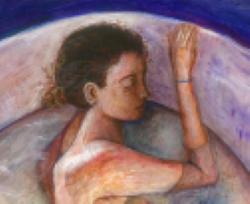
Art by Sophie Jenna
By Alex Smith
What has physiological birth in the privacy of one’s own home got to do with the maternity services? Intrinsically, nothing at all. Birth exists as an entity that is entirely separate from the maternity services.
Physiological birth happens from within. It happens autonomously and in its own time; the very last hours of a process that the body has been handling all along. It is an experience that unites women throughout all time and across all cultures.
Maternity care on the other hand happens from without. It is what is done to the mother. Maternity care follows an ever-changing, culturally influenced, pathologically focused, and medically prescribed schedule that often pays little regard to the physiological process.
This distinction is important because in most people’s minds the two have become entangled; so entangled that we have come to regard the routine components of maternity care as a normal and necessary part of every pregnancy and birth.
If I wrote at this point that the physiological process of labour and birth is more likely to happen smoothly and safely when the mother remains in the familiarity and privacy of her own home with minimal disturbance, I would be asked to provide a suitable reference with supporting evidence, but why? Why do we have to prove that normal is normal? We know it is normal for a mammalian mother to retire to her warm nest or den when the time comes. and that any disturbance could endanger her. The human mammalian mother is no different. We only have to step back and look at what is happening when women go into hospital to have their babies to know that they and their babies can be unsettled or even endangered in that setting. The burden of proof should be placed on the maternity services to show that routinely disrupting and medicalising a physiological process, in a way that leaves so many women feeling physically and mentally trampled, is appropriate or even safe.
This absurdity (the routine hospitalisation of women in labour) was beautifully described by the late Tricia Anderson. I warmly invite you to make yourself a nice cup of tea and to sit back and read Tricia’s wonderful timeless analogy . Although written 23 years ago, it is more relevant than ever today and should inform the required mindset for anyone offering maternity care. It says everything. Having read Tricia’s article, you may also enjoy reading it encapsulated into verse by Sara Wickham.[1]
Hospitalised birth - with its disturbing clinical paraphernalia, routine procedures, authoritative medical gaze, and fear of litigation - has become so normalised that very few midwives or doctors have ever seen a truly physiological birth,[3] except perhaps by accident when there simply wasn’t time to intervene. The authors of a recent review looking at this issue say:
“A risk-averse healthcare system could be a barrier to physiological birth. Dominant voices in the birthing space can dictate the way birth occurs. Lack of exposure to physiological birth may diminish the acquisition and maintenance of important skills and knowledge among care providers.”[4]
WIth escalating rates of inductions and caesareans (but no corresponding decrease in perinatal mortality by the by[5]) we are at risk of forgetting that, given half a chance, babies can also be born into warm quiet corners at home, between meals, in the normal course of a woman’s day. Whilst a completely undisturbed physiological birth might happen in hospital, it is a fact (rather than an opinion) that this occurs only rarely and is therefore, for the expectant parents, highly unlikely. In the 2008 documentary film ‘The Business of Being Born’, the late Marsden Wagner, former director of Women's & Children's Health for the World Health Organization, turns to the camera and says:
“The best thing to do if you want a humanised birth is get the hell out of the hospital.”
But is the pursuit of a physiological humanised birth at home a safe thing to do? It appears so - both for lower and higher risk mothers. Marjorie Tew’s study of births between 1940 and 1970 showed that outcomes for all but the very highest maternal risk group were better when they took place outside of the hospital,[6] and reviews of more recent data are drawing similar conclusions.[7], [8] It may be worth mentioning Ina May Gaskin’s midwifery practice at this point. Everyone she accepted for care in their community is included in the statistics and, in almost 3000 cases, close to 95% of the women gave birth safely at home with only lay midwives in attendance - including those with twins and breech babies - with a caesarean rate of 1.7% .[9] Of course birth, like life, is never completely without risk and outcomes for higher risk women giving birth at home are not quite as good as they are for lower risk women - but they are generally better than the outcomes of similarly higher risk women giving birth in hospital. Kathryn Kelly explored the evidence for these findings in her 2023 AIMS articles, Safety and the Place of Birth, parts one and two. More tea?

Before I move on to addressing the question of physiology informed maternity care and home birth, it feels important to explore why the home environment supports physiological labour during the time before the mother leaves her home or calls the midwife. This is the time when the mother is completely free to eat, drink and move about in tune with messages from her body. The sights, sounds, smells, textures and tastes of home, reassure her subconscious that she is safe. She may not be consciously thinking this; there may be a building sense of inevitability, a feeling of imminence. The normal sensations of late pregnancy are ebbing and flowing but gradually becoming more intense. The mother probably feels unusually focused on completing necessary household tasks and continues to prepare the meals and to put things in order.
Indeed, the rhythm of labour in the home setting is often measured by mealtimes and other references to food.
“Rose about five. Had early breakfast. Got my housework done about nine. Baked six loaves of bread. Made a kettle of mush and have now a suet pudding and beef boiling. My girl has ironed and I have managed to put my clothes away and set my house in order. May the merciful be with me through the unexpected scene. Nine o’clock p.m. was delivered of another son.” (Mary Walker)[10]
“Mother told me that labour started shortly after breakfast and I was here before supper.” (Personal communication)[11]
“I was born on Shrove Tuesday and Mum said that she made pancakes for the midwives.” (Personal communication)[9]
“In the afternoon I walked to a friend’s house, noticing the first waves of backache on the way. We had tea and cake and after an hour or so I walked home to put the dinner on. While dinner was cooking, I curled up with my toddler to watch a favourite film. We ate dinner together and as I rose from the table I heard my waters pop. By the time I had put the children to bed and had a warm bath it was time to call the midwife. She arrived barely in time to receive our new baby daughter.” (Personal communication)
Many women simply carry on with their daily routines and do not mentally set the labour clock ticking until they are sinking to their knees and have to give each wave of tightening their full attention. It is as if there is a double layer of privacy; the woman unwatched in her home, and her labour unwatched and unmeasured in the privacy of her body. If we are in pursuit of the truly undisturbed physiological process, these are probably the conditions in which it would be found. As Heisenburg’s uncertainty principle teaches us, ‘the observation of a phenomenon changes it’. The moment we look closely at something and try to measure it, it is not as it would have been when unobserved.
A friend wrote a beautiful account of her third birth for me that describes this double layer of privacy.
“It was two weeks after my estimated due date, and I made a little nest in my living room with candles, a deep birthing pool and a roaring fire. After five days of slow labour, there had suddenly been a surge of intensity in the pain. But it had been manageable, because I wasn’t physically tied down and restrained. And perhaps most importantly, my own body was creating that pain – it wasn’t artificial or man made. There were no measurements; I had no idea how ripe my cervix was, or how many centimetres it had dilated. I moved around and for not one second did it ever cross my mind to climb onto my bed and lie down on my back. The contractions came and went. Perhaps they were regular. Perhaps they were all over the place. I made no note of them.” (Personal communication)
An interesting study from Norway[12] describes the views of ten first time mothers who very intentionally and carefully planned to have their babies at home. They shared inner motivation and a deep faith in physiological birth and of the home as a place of safety, control and peace. One mother explained, “... all that I need exists within me”. Many kept their plans for home birth to themselves to avoid negativity from friends and family. This is another important and valuable layer of privacy; we all too easily absorb the fear of others and this instantly disrupts the physiological process.[13]
To summarise my points so far:
So, a woman in labour who has planned intentionally and carefully to have her baby at home; who believes that all that she needs lies within her; who, like my friend, has prepared a little nest in her living room with candles, a deep birthing pool and a roaring fire; decides it is time to call the midwife.
Women tell us that, even when the midwife is known and welcome, things change the moment she arrives. Hopefully, a known and trusted midwife will slide into the birth space almost unnoticed. She will quietly and unobtrusively tune into the energy and to what the mother may need from her, if anything at all. She is there to serve, not direct.
Today very few people can imagine how easy the birth of a baby and the delivery of its placenta can be when there is nobody around but an experienced, motherly, and silent midwife sitting in a corner and knitting (knitting as an example of repetitive tasks that help to maintain a low level of adrenaline). (Michel Odent)
There is a traditional association between midwives and knitting. Knitting has calming qualities that permeate the atmosphere. The aforementioned Trica Anderson coined the phrase, ‘drinking tea intelligently’. The midwife’s calm, unworried demeanour is infectious and helps the mother to move deeper and deeper into her birthing ‘zone’. Undisturbed, the mother’s appearance and her instinctive behaviours will indicate that things are progressing smoothly.[14] At the same time, the undisturbed mother is more able to tune into any sense that medical support or reassurance would feel welcome - just as we sense this with any other aspect of our physiology. An experienced, physiology-informed midwife is observant of these signs, bringing not just book-learning to her task, but mammalian senses and instincts of her own. Some even say that they can smell when the birth is imminent. There is little if any need for examination.[15] The physiology-informed midwife sets up a small space for herself in a dark corner or just outside the door and is there with the woman (the word midwife literally meaning with woman) in case her reassurance or skills are called for - called for by the mother, not by the protocol.

By contrast to physiology-informed midwives, ‘med-wives’ arrive at the home like the seventh cavalry ready to save the day with medical surveillance and adherence to protocols - protocols that do not understand or allow for the individual uniqueness of birth physiology. The mother may find herself accommodating her guests and deferring to them. She is probably expected to answer questions and submit to examinations. She may even expect and want this type of care, but every time the midwife listens to the baby’s heart some part of the mother’s psyche is waiting with bated breath to be reassured that all is well. With every offer of a vaginal examination the mother either has to decline or risk unwelcome news about progress. Either way, this is stressful and takes her out of her ‘zone’. Paraphrasing words from a Swedish study about birth environment, institutional authority permeates the atmosphere and the woman in labour becomes the compliant patient.[16] For better or worse, this inevitably changes the physiological process.
Another study explains that “the birthplaces of childbearing women are the workplaces of midwives”.[17] When midwives take over the home space and convert it to their work space by bringing, not only their institutional authority (symbolised and reinforced by being in uniform[18]), but all of their ‘stuff’, it shifts the balance of power. Present at births over the last few decades. I have witnessed this myself. Here is one such occasion.
Early morning, bird-song, warm summer air pouring through open windows, the two older children asleep in the big family bed. The mother wants the father to receive the baby in their bedroom. Presently she is leaning over the bathroom basin roaring like a glorious lion queen. Everything feels right; she is properly in her ‘zone’. Then the midwives arrive. “It’s alright, it’s alright, it’s alright” one of them shouts in a loud and breathless voice. “Yes, she is alright”, I try to reassure her in a whisper. “She is absolutely fine”. It is a shoe-free house for religious reasons, but the two midwives each make three loud clomping journeys up and down stairs in their outdoor shoes carrying boxes, canisters and bags, which they set out all over the bedroom floor. There is no longer room for the mother, so she stays in the bathroom. The mother asks me to ask at least one of the midwives to wait downstairs. I ask the ‘second’ midwife but she is visibly and audibly angry and says that she HAS to be in the room. I quietly remind her that she can only be there with the mother’s permission, so she kneels in the doorway and glowers. We try to defragment the medical clutter and to clear a space for the mother who returns and climbs onto the bed as there is still no floor space. My job is to wake the children to see the baby arrive and just as I do, the baby slides out into her father’s arms.
Not even a take-over was going to stop that baby, but the sense of invasion and the lack of respect and sensitivity led to this mother having freebirths with her next six children, very much echoing Kirkham and Plested’s (2016) findings[19] - and I was able to see why.
People who have attended ‘natural’ births and ‘natural’ deaths at home, often remark on the similarity. When the experiences of being born and dying are seen, not as pathological events but as natural stages of a physiological continuum…as life transitions with profound social and spiritual meaning for each individual…it becomes easier to understand why a medical environment is rarely appropriate. The optimal environments for birth and death have much in common. For physiological processes to unfold as smoothly as possible, the body requires levels of privacy, intimacy, and familiarity that are trampled upon when nurses or midwives seek to take over and adapt the space to meet their own requirements. Rather than being reassuring and welcome, research suggests that the ‘institutionalisation’ of the home space for dying is perceived as a negative thing by family members, though (such is the power of cultural indoctrination) it is taken as a given.[20] But it is not a given. Any medical care (for death, birth and anything in between) is legally by invitation only.
Fifty years ago, Ivan Illich warned about ‘the medicalisation of life’ and the dangers of this.[21] We need to remove our blinkers, step back, and check for sure that at any point the maternity services come face to face with birth, no harm is done. This study exploring women’s psychological experiences of physiological childbirth, concludes:
“Giving birth physiologically is an intense and transformative psychological experience that generates a sense of empowerment. The benefits of this process can be maximised through physical, emotional and social support for women, enhancing their belief in their ability to birth and not disturbing physiology unless it is necessary. Healthcare professionals need to take cognisance of the empowering effects of the psychological experience of physiological childbirth.“[22]
Another way of saying ‘unless it is necessary’ is to say, ‘unless it is called for’. Physiology-informed midwives will trust the mother to do the calling, and, if and when she does, they will be with her.
Author Bio: Alex is the editor for the AIMS journal, a grandmother and great grandmother, and witness to some truly wonderful physiological births. She has close to half a century’s experience as a childbirth educator.
[1] Sara Wickham (2020) A Tribute to Tricia’s Lab Cats www.sarawickham.com/fun-stuff/a-tribute-to-tricias-lab-cats
[2] Image source: www.rawpixel.com/image/12706629/png-teacup-porcelain-saucer-coffee-generated-image-rawpixel
[3] I attended a meeting recently where the Chair, an obstetrician who had herself had a baby at home, told us that obstetricians have hardly any training in physiological birth and probably only ever see one (if ever) by accident. Their training is almost solely in pathology.
[4] Henshall B.I., Grimes H.A., Davis J., East C.E. (2024) What is ‘physiological birth’? A scoping review of the perspectives of women and care providers, Midwifery, Volume 132, 103964, ISSN 266-6138. https://doi.org/10.1016/j.midw.2024.103964.
[5] Downe S., Kingdon C. (2025) Caesareans are rising fast in the UK – but giving birth is getting worse for women. The Conversation. https://theconversation.com/caesareans-are-rising-fast-in-the-uk-but-giving-birth-is-getting-worse-for-women-246211
[6] Tew M (1998) Safer Childbirth? a critical history of maternity care. (2nd Edition). London. Free Association Books Ltd.
[7] NPEU (No date) Birthplace in England Research Programme www.npeu.ox.ac.uk/birthplace
[8] Wickham S. (2025) Is home birth safe? www.sarawickham.com/research-updates/is_home_birth_safe
[9] The Farm Midwifery Center (2010) Preliminary Report of 2,844 Pregnancies: 1970-2010 https://thefarmmidwives.org/preliminary-statistics. All the transfers were completed safely.
[10] Ed.Nancy Caldwell Sorel (1984) Extract from the journal of Mary Walker (1800s) In: Covered Wagon Confinements. Ever Since Eve: Personal reflections on childbirth. New York. Oxford University Press.
[11] This communication, and the following one, were shared with me during an antenatal class about 30 years ago. I asked the group of about 12 people what they knew (if anything) about their own births. Half of the group had been born at home and half in hospital. The difference between the accounts was striking. All of the hospital birth stories were about procedures and shift changes, whereas all of the home births involved food.
[12] Tuva Falch Skrondal, Trine Bache-Gabrielsen, Ingvild Aune (2020) All that I need exists within me: A qualitative study of nulliparous Norwegian women's experiences with planned home birth. Midwifery Volume 86, July, 102705
[13] Author’s note: The obstetrician mentioned in footnote 2 said that she too had not told many friends and colleagues about her home birth plans because she did not want to be exposed to their fear - a fear arising from simply not knowing about physiological birth.
[14] Reed R. (2025) Understanding and Assessing Labour Progress www.rachelreed.website/blog/understanding-labour-progress
[15] Reed R. (2025) Vaginal Examinations: stuck on the cervix www.rachelreed.website/blog/vaginal-examinations-in-labour
[16] Goldkuhl L., Dellenborg L., Berg M., Wijk H., Nilsson C. (2022) The influence and meaning of the birth environment for nulliparous women at a hospital-based labour ward in Sweden: An ethnographic study, Women and Birth, Volume 35, Issue 4, Pages e337-e347, ISSN 871-5192, https://doi.org/10.1016/j.wombi.2021.07.005
[17] Davis D.L., Homer C.S.E. (2016) Birthplace as the midwife's workplace: How does place of birth impact on midwives? Women and Birth, Volume 29, Issue 5, Pages 407-415, ISSN 1871-5192. https://doi.org/10.1016/j.wombi.2016.02.004.
[18] Bickman, L. (1974) The Social Power of a Uniform. Journal of Applied Social Psychology, 4(4):47-61. www.researchgate.net/publication/261402118_The_Social_Power_of_a_Uniform
[19] Plested M., Kirkham M. (2016) Risk and fear in the lived experience of birth without a midwife. Midwifery Vol 38, pages 29-34. www.sciencedirect.com/science/article/abs/pii/S0266613816000474?via%3Dihub
[20] Morris S, King C, Turner M, Payne S. (2015) Family carers providing support to a person dying in the home setting: A narrative literature review. Palliative Medicine. ONLINE https://journals.sagepub.com/doi/full/10.1177/0269216314565706
[21] Biley F.C. (2010) The ‘Sickening’ Search for Health: Ivan Illich’s revised thoughts on the
medicalization of life and medical iatrogenesis. https://citeseerx.ist.psu.edu/document?repid=rep1&type=pdf&doi=5ae20b369fc95ac4a343a6da7560905ceb2593a2
[22] Olza I, Leahy-Warren P, Benyamini Y, et al (2018) Women’s psychological experiences of physiological childbirth: a meta-synthesis. BMJ Open 2018;8:e020347. doi: 10.1136/bmjopen-2017-020347 https://bmjopen.bmj.com/content/8/10/e020347
Please feel free to download and share a pdf of this article. If you wish to use AIMS copyright material please see aims.org.uk/general/aims-copyright
If you found this article helpful please consider becoming an AIMS member or making a donation to support our work. We are a small charity that accepts no commercial sponsorship, in order to preserve our reputation for providing impartial, evidence-based information.
AIMS supports all maternity service users to navigate the system as it exists, and campaigns for a system which truly meets the needs of all.
