
AIMS Journal, 2025, Vol 37, No 4
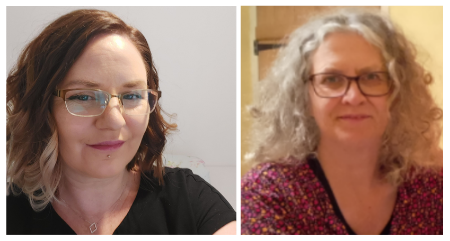
By Claire Feeley and Jo Dagustun
Jo
The text I share with you below has been written by a midwife called Claire Feeley. Claire is a midwife, currently working as a senior lecturer and academic researcher at Kings College London (KCL). At a time when many are questioning the value of midwifery in the UK, Claire’s words are testament to the benefits that humanised and properly practised midwifery can bring. Midwives are the key professionals in this endeavour. Claire’s reflections on her experiences, which underpin her own commitment to midwifery, are poignant and deeply personal. But their importance stretches beyond the personal. I believe that Claire offers her important insights into why midwifery matters, preferably within a relational (or midwifery continuity of carer) model of care.
Claire’s reflections showcase how sensitive midwifery can play a vital role in supporting women to appreciate our own worth and power, and to build our lives in ways previously unimaginable. As such, good midwifery acts as a poorly recognised enabler of wellbeing and equity. Thank you Claire, for agreeing to share your reflections here, and for the work that you continue to do for women, babies and their families. Thank you to every midwife who is sticking with it, despite the public debate which is often intensely hostile to the role of midwives. Thank you to every other healthcare professional who is seeking to deliver high levels of midwifery care (which is not just restricted to midwives). Midwifery is a precious activity, and multi-professional teams are much-the-poorer without it, unable to deliver some of the key outcomes that Claire describes so well. But let’s hear from Claire, in her own words.

Claire
My commitment to midwifery is not a professional project because I need to keep my job; I'm bright, have transferrable skills and literally could be doing many other things with my time right now. BUT I'm here, holding a line to protect midwifery as a mother FIRST AND FOREMOST.
I was 23 when I was pregnant (planned and wanted) and had a hard, tough exterior borne of a multitude of childhood trauma. Then I met my midwife, a real midwife, who quite simply supported me, trusted me and my decisions, she started to melt my tough exterior.
I went into labour and had a (different) wonderful midwife come to my home, she didn't insist on vaginal examinations and let me just labour in the way I needed to. Then my antenatal ‘continuity of carer’ midwife rearranged her day to come and be with me. Long story short, despite a baby on board who was facing ‘the wrong way’ (OP, or occiput posterior), a mini meltdown and a quick efficient transfer to hospital (with said midwife with me the whole time), I birthed my gorgeous son ALL BY MYSELF.
Beyond the empowerment, the joy, the exultant feeling of how brilliant my body was to grow and birth my baby, something else magickal happened. Unbeknownst to me, this birth, more importantly this MIDWIFERY care, based on trust for the first time in my life, helped me overcome my significant childhood trauma and healed me in ways I could never have expected or known possible. The longer term implications are too much to describe in this post.
But when I say birth can be life-changing and transformative, I have this first hand experience of something so beyond simply pushing a baby out of my vagina. I also believe that, even if I'd needed an intervention, the love, support and trust imbued by my midwives would still have resulted in this transformative effect. That I had both great care and the birth I wanted happened, gave a double whammy of something out of this world, and that something guides my work everyday.
I want everyone to feel loved and cherished, listened to and supported during pregnancy, birth and that vital postnatal period - and I do believe authentic midwifery is the vehicle that is most likely to drive this possibility.
Mum first, midwife second, researcher third. We need to hang on and save midwifery, it's never been so important ❤️❤️❤️❤️❤️❤️
AIMS comment
When Jo read this piece by Claire, she was certain that it needed to be published in a less ephemeral space than facebook, and she took action to bring it to you here - thank you Jo! Perhaps you have your own story to tell of why midwifery matters. If so, please get in touch (with alex.smith@aims.org.uk), to explore further whether you might wish to share it with our Journal readers.
Yes, many of us also have stories to tell about where individual midwives have not lived up to our expectations, sometimes with devastating results. For AIMS, these stories are also an incredibly important resource. Paying close attention to these will help ensure that the delivery of midwifery in the NHS truly serves everyone well. Women, babies and families, everywhere, no matter what turns the maternity journey takes, deserve no less.
Author Bios:
Claire Feeley - Qualifying as a midwife in 2011, earning an MSc in 2015, and a PhD in 2019, Claire has worked clinically in all areas of midwifery, in all settings, and across different organisations, across all birthplace settings – specialising in physiological birth across the risk spectrum, water immersion, advocacy and change implementation. Claire’s primary research focus has been on the sociocultural-political components of maternity care provision including access, engagement and care delivery. Claire has published numerous peer-reviewed articles, two monographs, professional articles, book chapters, in addition to presenting nationally and internationally. Now a Senior Lecturer and researcher at King’s College London and a freelance consultant, Claire can be contacted at www.clairefeeley.com
Jo Dagustun - Jo Dagustun, mum of four, has been an AIMS Volunteer since 2017. Jo is a geographer and civil servant by background, and wrote a PhD on women's birth experiences (Learning to birth, mastering the social practice of birth: conceptualising women as skilful and knowledgeable agents). As well as working with others to understand and improve maternity services in the UK, Jo enjoys tutoring on The Brilliant Club's free to access Scholars Programme and spending time by the sea.
Please feel free to download and share a pdf of this article. If you wish to use AIMS copyright material please see aims.org.uk/general/aims-copyright
If you found this article helpful please consider becoming an AIMS member or making a donation to support our work. We are a small charity that accepts no commercial sponsorship, in order to preserve our reputation for providing impartial, evidence-based information.
AIMS supports all maternity service users to navigate the system as it exists, and campaigns for a system which truly meets the needs of all.