
AIMS Journal, 2025, Vol 37, No 4
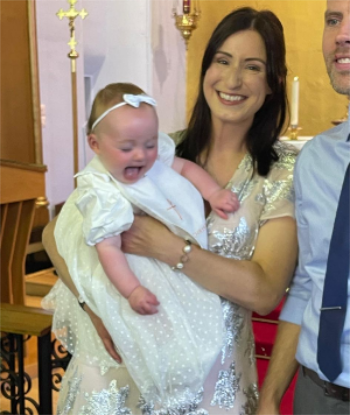
By Mary Smith
From a young age, my dream was to be a mother—at one point fantasising about having five kids! Growing up with nine siblings, that didn’t seem ridiculous. But, deep down, I always had a feeling that motherhood wouldn’t be straightforward for me.
I got my first period at 12 and endured excruciating pain, which only got worse over time. Despite being prescribed stronger painkillers by doctors, I was often bedridden.
At the age of 29 I had a short but intensive period of serious ill health with symptoms of some sort of bowel issue, and was referred to a colorectal clinic. The consultant was confused by me being there. Based on my history, endometriosis was suggested and so he referred me to a gynaecology colleague. Sadly, before this line of enquiry could be followed up, I became acutely unwell and presented at A&E where this very colorectal surgeon was the receiving surgeon on shift! Fate!! I was hospitalised and had an emergency sub-total colectomy (part of the colon removed) resulting in an ileostomy (a surgical procedure that brings the end of the small intestine out through an opening in the abdomen), without which I would have died.
I cancelled my upcoming wedding and spent 7 weeks in hospital, including my 30th birthday. My mental health plummeted. There had been a large endometrial stricture in my bowel and I was finally diagnosed with endometriosis - 17 years after my first period. What came first, ulcerative colitis or endometriosis? My surgeon felt that endo was more likely given my history of symptoms.
I came off the pill to try for a baby, but this resulted in such severe period pains that I ended up in A&E most months requiring intravenous morphine. I tried to carry on as normal, worried I would lose my job. I was referred to a gynaecologist who specialised in endometriosis and was referred for IVF.1 She insisted on writing a letter to request my employer support me with flexible working each month. It was discovered I had a hydrosalpinx (fluid blockage in the fallopian tubes) and so came my second surgery - two weeks after my wedding. We managed my symptoms up until the wedding with me again living off painkillers.
My lovely consultant operated, trying hard to preserve access to my right ovary for IVF after it became apparent that my left ovary was not an option. Not long afterwards, I began having kidney issues, discovering that scar tissue had damaged both ureters. My left kidney function had dropped to 5% and was causing more harm in than out and so I had a third surgery, to remove my kidney. My right kidney slowly healed and now functions relatively normally although I remain at risk of kidney issues for the rest of my life.
The time finally came to embark on IVF, but tests revealed I had an incredibly low egg count, believed to be due to surgeries, and so I was very bluntly asked if I had any sisters. When I advised I had 7, the fertility consultant gleefully asked if I could ask them for egg donation. This completely threw me! Not only was I facing IVF, but I was also unable to biologically conceive my own baby!! How could I possibly ask a sister to donate eggs?! I vividly remember thinking “It is not like asking to borrow £10!”.
I had confided in only one of my sisters about IVF and so after this devastating appointment we went to see her, inconsolable. She offered to be our egg donor without hesitation and so our first angel showed us her wings. She had 2 children of her own, was not looking to have any more and in her eyes felt she lost an egg every month naturally and so why not put some of them to good use!
IVF was physically, emotionally and mentally draining and I felt immense guilt at what my sister went through. Five beautiful embryos were created and one was implanted five days later. After another ten days we discovered I was finally pregnant!
I could not celebrate. So many what ifs and the terror of miscarrying. It remained a secret until 14 weeks, only telling immediate family. It was a high-risk pregnancy and so began the multiple hospital appointments. My 20-week scan revealed placenta previa and so the initial plan for a vaginal delivery was no longer an option. The biggest concern during pregnancy was the risk of bleeding due to placenta previa. However, my kidney was struggling without anyone knowing or realising. At 35 weeks I had a minor bleed. Blood tests revealed that my kidney was struggling and to this day I am convinced that this was my body’s way of looking out for my kidney. I had a planned c-section at 37 weeks. Initially all seemed to be well but sadly, at 12 hours old, my daughter started having choking episodes and showing signs of infection and so she was moved to NICU (neonatal intensive care unit). Thankfully, after a week in neonatal, we were both discharged home. I struggled with postnatal anxiety and as a result struggled to switch off and sleep. I went to the GP and saw a locum who advised that “the first 6 weeks of having a baby are hell on earth for anyone” and sent me on my way. It wasn’t a great surprise that I ended up in A&E that evening and was prescribed sedatives to support sleep. This is not the motherhood that I had envisaged and so desperately hoped and prayed for!! I look back on this time with such sadness.
Three years later we embarked on IVF again. It was even less straightforward this time and took five attempts and another sister donating eggs. Life was on hold for 4 years, with boundless energy and money thrown at every attempt, sadness and anger after each failed attempt. I felt such injustice. My daughter was desperate for a sibling and talked about this often. During this time, I also underwent further major surgery, including an ovary being removed, and so I was put into early menopause. The symptoms were debilitating until commencing HRT, which has been life-changing.
My life was a never-ending merry-go-round of hospital appointments, fertility appointments, surgery, recovering from surgery, and putting a brave face on, never allowing anyone to know the full impact this had on me, telling myself over and over that it would all be worth it once I had another child. I could not allow myself the thought that there may not be another child. A fifth embryo transfer resulted in pregnancy but yet again I could not celebrate it, tell anyone, too scared to even think too hard about it. We told my daughter at 16 weeks; she was the first to find out, but this filled me with such anxiety. What if the pregnancy did not work out and I dashed her hopes and dreams that had finally been fulfilled!! At 22 weeks it became apparent that I had placenta previa again and was advised the pregnancy could not go beyond 36 weeks. One of my consultants advised there was a risk the placenta would embed in the uterus resulting in a hysterectomy. This was checked every few weeks and thankfully was not the case.
A close eye was kept on my kidney, learning from my first pregnancy, and at 24 weeks, I was admitted for an urgent MRI which revealed hydronephrosis (a condition of the urinary tract where one or both kidneys swell) and so I was faced with a choice of two difficult and complex interventions. I could have stents which would have to be put in under general anaesthetic and run the risk of not working or damaging the ureter and in turn my remaining kidney. The second option was to have a nephrostomy (a tube that lets urine drain from the kidney through an opening in the skin on the back) which could be fitted under sedation. I had had stents before without issue and so if not pregnant then this would have absolutely been my choice, but I was told a general anaesthetic carried a risk of premature labour. I asked for this risk to be quantified and explained further, only to be told no one knew – my team had never had a patient in this position and so I was left to make the decision. In addition, Urology was not based in the same hospital as Maternity and so all communication with the urology consultant was done via a phone call.
One of the midwives on the ward went out of her way to help, going away and researching both options and printing out paperwork for me to read. She also told the urologist that I would not be giving a decision that night and I needed time to think and sleep on it. The next day I spoke to one of my consultants and told her I felt it was unfair that I had been left to make this decision myself without full information. She apologised and agreed she should be helping me to decide; we talked it through, and it appeared that the nephrostomy would give me the better chance at getting to 36 weeks and, although invasive, had evidence of successfully helping with hydronephrosis. The procedure was very difficult both physically and mentally to deal with, including some complications and a rare kidney infection which required intravenous antibiotics plus multiple other hospital visits and home monitoring due to having a higher risk of pre-eclampsia.
During one hospital admission I was advised I had to give birth under general anaesthetic as I would be having a vertical incision, much more invasive and bigger recovery than a standard c-section. I was devastated. I had had experience of this type of surgery twice before and knew what recovery entailed, now with the addition of a premature baby to look after. Surgery was scheduled for 34 weeks, 2 weeks earlier than expected, due to diary management and consultants from two hospitals being required, also due to the worry that something would go wrong and so to prevent emergency surgery. I was not going to be able to have skin to skin contact with my daughter, or check that she was ok. I was inconsolable. I felt huge guilt that it was my fault that she was being born early, especially if she was unwell as a result.
I was reassured that babies generally do well at 34 weeks. One of my consultants recognised the mental toll this was taking and so referred me to the MNPI team (Maternity & Neonatal Psychological Interventions). We had limited time to work together before the birth and so focused on creating a birth plan - something I could not have imagined. It specified: the need for my own room where possible; baby would be introduced to me (albeit I would be unaware) before being treated; my husband would stay with baby, which meant I would need another birthing partner to be with me in recovery; bonding squares; and for my husband to have skin to skin if possible. I am happy to report that all were fulfilled, although I am still sad that I remember very little of the first five days of my daughter's life. The only clear memories I have are being taken to see her and being annoyed and frustrated that I could barely keep my eyes open, as well as vividly remembering the nephrostomy being removed which was extremely painful and a story for another day!
I saw my community midwife for all standard appointments but as I was consultant led; it sometimes felt this was a bit of a tick box. However, she was wonderfully empathetic and in fact gave the heads up that I may struggle to produce enough breast milk given I was having major surgery and was on HRT. So she gave me information regarding a medicine to increase supply should it be required. This was never mentioned in hospital, and so she gave me the confidence to ask for this and it was approved, much to people's surprise.
Despite the complexities and trauma of this pregnancy, I am incredibly lucky to have had two wonderful consultants who held my hand along the way and ensured they saw me for all appointments except one! They admitted they had not dealt with such kidney issues before and so ensured they called on the appropriate expertise. I had a debrief phone call a few months afterwards to ensure I was happy with all that happened and to see if I had any questions, which is not something I expected but really appreciated.
I had 2 very different pregnancies and very complex journeys to becoming a mother, neither of which I would wish on anyone. There are undoubtedly additional complexities for women with 2 or more health conditions and the burden that falls on women in such circumstances can be phenomenal. I felt like a walking set of medical notes, worrying whether I had provided the correct information. Although well meaning, it was also difficult to listen to people comment on my “very complicated medical history”, “oh wow, you have been through lots”. I am well aware, I have lived through it all! However, I am here and still fighting and I have no doubt in my mind that I had a more positive 2nd pregnancy due in part to my ability to advocate more fully for myself.
To those reading this and going through similar, please do not think you are alone. It is indeed a lonely journey but there are things you can do to take control and make the experience a more positive one.
Find people to celebrate with
Don’t feel obligated to let people know when you are due (I constantly felt like I would say my due date and then follow up with “oh but she will be early”)
Don't be afraid to ask questions, questions and more questions.
Don't be afraid to take some time to consider things and think things through.
Write your questions down before appointments so that you have just as much input in appointments.
Don't be afraid to ask for appointments to be amalgamated to save time, money and stress on multiple appointments.
Ask your consultants about whether peer support is available.
DO NOT BLAME YOURSELF! I cannot stress this enough. You are doing an amazing job, keep doing what you are doing and just take things a day at a time
Look for support groups for specific specialities. This really helped me with regards to the nephrostomy.
You CAN have a birth plan, even if you are having surgery.
Enjoy every little snuggle and breathe that baby in.
Know that you did everything that you could.
It IS ok to have bad days, to struggle, to be upset. Most people do, whether they show it or not!
Believe in yourself.
Author Bio: I am Mary, I am 42 years old and mum to 2 precious girls. I am an NHS patient pro at this point and eternally grateful to them for saving my life and for giving me my 2 girls.
1 Editor’s note: IVF stands for in vitro fertilisation is the process where the egg is harvested from the mother or a donor and fertilised by sperm in a laboratory. The fertilised egg is then implanted into the mother’s womb. The Latin words ‘in vitro’ translate as ‘in glass’.
Please feel free to download and share a pdf of this article. If you wish to use AIMS copyright material please see aims.org.uk/general/aims-copyright
If you found this article helpful please consider becoming an AIMS member or making a donation to support our work. We are a small charity that accepts no commercial sponsorship, in order to preserve our reputation for providing impartial, evidence-based information.
AIMS supports all maternity service users to navigate the system as it exists, and campaigns for a system which truly meets the needs of all.