
AIMS Journal, 2026, Vol 38, No 1
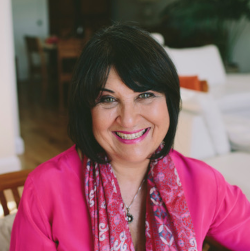
By Janet Balaskas
Many years ago, in the late 1970’s, I gave birth for the first time. A few weeks before the birth I came across Grantly Dick Read’s book – ‘Childbirth without Fear’. I had a sense that I could do it and this book resonated well with me. The birth went well; however, I was given an unnecessary episiotomy without consent and gave birth semi-reclining. I did not even know what an episiotomy was. This experience gave me a wonderful daughter and inspired my recognition that there was a need for pregnant women to be educated and empowered. It sparked my passion.
I then trained with a well-known national organisation to become a birth educator. The classes I observed were held mainly for women and their partners in the last trimester of pregnancy. They were taught ‘classroom style’ as a course of 4 sessions - participants were given a lot of information – mainly about interventions, hospital routines and a rudimentary description of the ‘stages of labour’. A few breathing techniques, some relaxation and massage were taught, with the women semi-reclining passively or at best seated in chairs. The physiology was completely missing.
At the class reunion, I noticed that the outcomes were disappointing in the sense that most women, with few exceptions, succumbed to a medicalised birth in a hospital setting. I felt that antenatal education needed a radical new approach to be effective. That was a long time ago and things have changed and improved considerably. However, some of my ideas have proven to be effective and I would like to essence them here.
Pregnancy lasts nine months for a reason. It takes that long for the baby to develop in utero, and I think it also takes that long for a woman to prepare herself for birth and mothering. Running a course of information-based antenatal classes in late pregnancy completely misses the opportunity to work with a woman through this journey, when she is experiencing so much change and transformation. I believe there is a need for her to prepare physically and experientially, as her body changes.
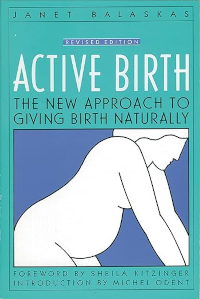
So, I developed a new idea of inviting pregnant women to join a weekly ‘yoga based’ exercise class. This was ongoing throughout the rest of their pregnancy from whenever they joined up until the birth. Instead of a ‘course’ as such, this was more of a shared weekly group experience – a programme of gentle exercises, which prepared them for the possibility of an ‘active birth’. My ideas about Active Birth were developing at the same time. I published a book and organised two big conferences to explain the benefits of encouraging women to be free to move and to use upright positions which harness the help of gravity. I also published the Active Birth Manifesto which outlined the benefits and included a list of research references.
Many simple yoga positions resemble gravity effective labour and birth positions. By practising them regularly in pregnancy, women embody the forms and movements that are natural and instinctual in labour. They become comfortable in kneeling positions such as all fours, easy squatting, standing squats, standing and rotating the hips or leaning forward. The very same movements and positions make pregnancy more comfortable and enjoyable, improve posture and ease aches and pains. That is what I mean by experiential learning.
The woman begins to connect with her body and her baby in a way that builds her confidence in her ability to birth her baby. This kind of ‘body centred’ education naturally awakens the instinctual behaviour of birthing. The teacher does not need to be a yoga teacher to do this. So long as she can be comfortable herself in these positions and movements, she can create a circle where there is enough space and a few simple props such as cushions, yoga mats and possibly birth balls. The consistent weekly presence of the teacher provides continuity, warmth and wisdom that gives a holding context to the pregnant women that is very valuable and supportive.
Over the years I evolved a basic series of exercises and offered training to teachers.
As the group includes women at different stages of pregnancy, it is a wonderful peer support group, where sharing a cup of tea at the end is an education in itself. Most weeks a mum from the group who had recently given birth is invited back to tell her birth story and introduce her baby! A good debrief for her, a learning opportunity for the other group members, and such a joy to see the baby and perhaps witness breastfeeding!
The teacher here is a facilitator who leads the exercise session and then gently guides the group discussions and perhaps introduces a topic of conversation when the need arises. Each class includes a relaxation at the end and sometimes at the beginning too, if the women arrive tired after work or travelling.
Breathing is a continuous theme throughout – spontaneous rather than ‘techniques’ – and that translates effortlessly into a wonderful, learned skill of how to ‘breath through’ the intensity of labour contractions and to ‘breathe the baby out’ during birth (sometimes noisily!) I would often get on my hands and knees, roll my hips and give them a demonstration of what that might sound like.
Early evening is usually a good time for such a class, so women can attend after work and the weekends are free. Each session lasts an hour and a half including the teatime at the end. I usually ask women to commit to a package of four or six classes, and this can be renewed ongoingly.
However, it is important to also provide a more formal and organised course of information and to engage the partners.
In addition to these ongoing weekly women’s circles, I run regular workshops or weekend courses which include partners. While women’s groups are uniquely empowering, the partner needs to be involved, prepared, informed and engaged. My priority here is to provide evidence-based factual information and a forum for discussion and questions.
I start with an overview of the whole continuum of the birth process (rather than ‘stages’ of labour), the marvellous physiology of a birthing woman’s body – the anatomy of the pelvis – the journey of the baby – and all the principles and benefits of an active birth. Demonstrating this with a model pelvis and baby doll is a highly effective way to teach this – creating a visualisation in 3D of what happens inside the mother’s body during labour and birth. Partners can really relate to this, and I believe it helps them enormously to understand what is happening to mother and baby during the actual labour and birth. They often become less fearful, more confident and leave looking forward to the experience.
I also include the physiology of the uterus, and the wonderful hormonal systems that initiate labour and underlie the physiological responses that bring the baby to birth. Over the years I have found many creative and interactive ways to demonstrate and teach this material simply.
The more I have learned about the arousal of the ‘primitive brain’ and the quietude of the neo cortex or ‘thinking brain’ during labour and birth, the more I have understood why my approach to birth education works. A pregnant woman naturally loses her capacity to engage with neocortical stimulation – we call it ‘baby brain’. Education that is not only information based but helps her endorphin release, such as the weekly exercise and relaxation class, or touch between partners in a group session that builds oxytocin release, is essential.
I believe strongly that even in the context of a course or workshop, learning needs to be experiential and embodied rather than only a delivery of information. So, I would have couples trying out labour and birthing positions using role play. I was often astonished how engaged they were, how much natural affection was expressed – sometimes the room felt like it was full of oxytocin and endorphins. It’s a joy to teach like this.
I would frequently address the partners, for example getting them to imagine holding their child for the first time and looking down into those newborn eyes etc. More than once I have seen a grown man holding a baby doll with tears in his eyes!
Last, but by no means least, there is also a need to manage expectations, so they are prepared to face the unknown and to cope well when plans need to change.
In the current climate women and their partners need to learn about the possible use of interventions, advocacy, assertiveness and effective communication with their carers. These issues are usually addressed in antenatal classes these days and so they should be. These conversations also come up more informally in yoga classes, so I recommend that a good antenatal teacher needs to be up-to-speed with delivery of evidence-based information in both contexts.
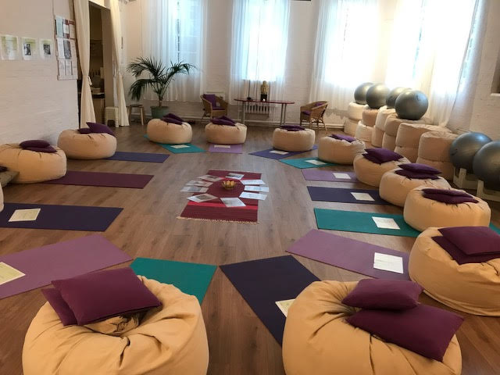
To summarise - A course or workshop in the third trimester which includes partners is an essential, alongside an ongoing weekly programme where pregnant women can relax, breathe, practise ‘yoga based’ simple exercises together and learn from each other.
This extends very naturally into a weekly postnatal class where new mums can meet in a group with their babies. The mums do gentle postnatal exercises to strengthen after birth, or if the baby is awake and calling, to breastfeed and watch – followed by a circle of very basic baby massage (we invented this too with the help of Peter Walker who was babysitting for me at the time!).
The atmosphere in the room was usually calm and magical, until the babies must be dressed and then it is pandemonium! For some new mothers this group is a ‘life saver’ to quote one of them. This then developed into ‘Mothers Talking’ groups – birth to toddler. These we led by Naomi Stadlen the Author of the wonderful book ‘What Mothers Do - Especially when it looks like nothing.'
This I believe to be a model of good ante and postnatal education throughout the perinatal period, rather than ending at birth.
Approaching my 80’s I am now committed to training teachers in my methodology together with my most experienced colleagues. We have found that this can be done successfully over zoom and are developing a programme.
Information will be published in the coming months on www.activebirthcentre.com.
The Active Birth Manifesto is available free on request from info@activebirthcentre.com
Author Bio: Janet Balaskas is a renowned antenatal teacher and the founder of Active Birth. Her innovative ideas have been influential in changing the landscape for education throughout the perinatal period and during birth, opening up options for choice in these areas that did not exist 50 years ago.
The AIMS Journal spearheads discussions about change and development in the maternity services..
AIMS Journal articles on the website go back to 1960, offering an important historical record of maternity issues over the past 60 years. Please check the date of the article because the situation that it discusses may have changed since it was published. We are also very aware that the language used in many articles may not be the language that AIMS would use today.
To contact the editors, please email: journal@aims.org.uk
We make the AIMS Journal freely available so that as many people as possible can benefit from the articles. If you found this article interesting please consider supporting us by becoming an AIMS member or making a donation. We are a small charity that accepts no commercial sponsorship, in order to preserve our reputation for providing impartial, evidence-based information.
AIMS supports all maternity service users to navigate the system as it exists, and campaigns for a system which truly meets the needs of all.