
AIMS Journal, 2026, Vol 38, No 1
By Alex Smith
I was in a discussion with Danish midwife Jacqueline Vejlstrup recently and it really got me thinking. I want to share my reflections about her thoughts as they felt so relevant to this quarter’s journal theme on antenatal education.
Jacqueline was expressing her deep concern that normal birth is no longer regarded as “a neutral, health-promoting physiological reference point” but is increasingly framed as “a normative problem: potentially exclusionary, culturally loaded, even harmful” - that respect for the physiology of the body has become regarded as a dangerous ideology.
If women, their families, midwives, obstetricians and society at large do not educate themselves about the implications of this shift we are probably witnessing the end of natural human childbirth, making this the single most important challenge in antenatal education today. It makes for uncomfortable learning, but as Aristotle said, “The roots of education are bitter, but the fruit is sweet.”1
For any reader who has not questioned this shift yet, it helps to consider how we would feel if we were witnessing the end of any other physiological process, for example:
Breathing - what if the majority of us required mechanical breathing assistance and were all equipped with masks, tubes and oxygen tanks?
Digestion - what if the majority of us required artificial feeding either with prescribed nutritional pouches that were easier to digest because our bodies were mostly not up to coping with real food, or even with many of us having central lines installed routinely?
Conception - What if the majority of pregnancies required IVF and natural conception was actively discouraged as being reckless? And what if artificial wombs became the reality?
We would think we had woken up in a dystopian Sci-Fi horror movie.
The shift has been so insidious, and in some ways so seductive, that we can be forgiven if we are only waking up to the gravity of the situation now. But anyone who considers themselves an authority in childbirth, and certainly anyone who considers themselves to be an antenatal educator, should have seen this coming. Karen Lawrence's fictional story, The Last Midwife, is worryingly unfarfetched. We have a moral and ethical duty to ensure that everyone understands that what we are witnessing in the birth world is NOT normal or desirable; it is what Doris Haire, as long ago as 1972, referred to as the cultural warping of childbirth and it is not serving us well.
We are each of us conscious of what we believe we know about the world - although, what I know may not be what you know. We have also internalised a much greater body of belief about the world that has slipped in unconsciously and that simply feels like common sense. As Einstein is quoted as saying, “Common sense is the collection of prejudices acquired by age eighteen” - prejudices because we have not yet evaluated or judged them. For example, it feels like common sense to say that birth must always be safer in a hospital - but is it? The idea is a cultural construct, not a law of nature.
Physiological processes on the other hand are inherent to nature. They are fundamental, essential characteristics that are built into us from the very beginning, making them part of who we really are - our unwarped human selves.
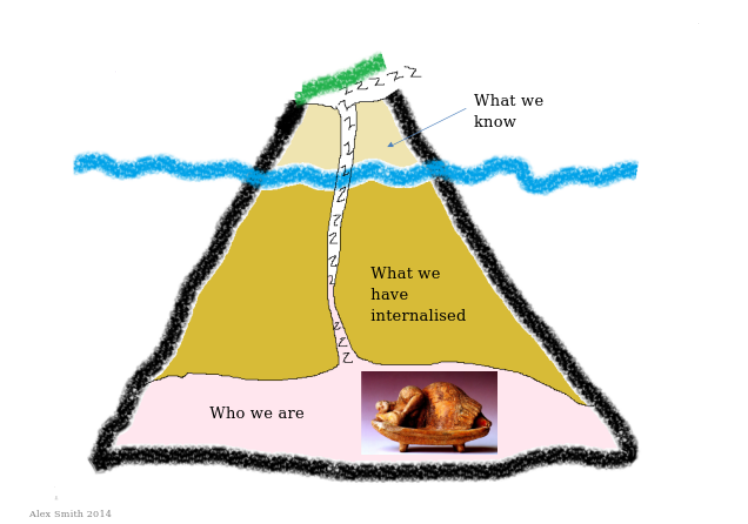
The word education has the Latin root educere meaning ‘to draw out’. It refers to the bringing forth of inherent abilities, guiding someone to discover their potential - who they are (represented in the image above by the Sleeping Lady of Malta). There is a biological imperative that women have an inherent ability to carry, bear and feed their babies, and if undisturbed (unwarped by cultural constructs) these physiological processes generally serve us well.
Transformative learning theory recognises that learning is uncomfortable. The learner will be faced with ‘disorientating dilemmas’ and the need to re-examine deeply internalised assumptions, (perhaps the doctor is not always right - perhaps hospital birth is not always safer). These assumptions, that had felt like common sense, often reflect the prevailing hegemonies of the day.
“By hegemony, Gramsci meant the permeation throughout society of an entire system of values, attitudes, beliefs and morality that has the effect of supporting the status quo in power relations. Hegemony in this sense might be defined as an 'organising principle' that is diffused by the process of socialisation into every area of daily life. To the extent that this prevailing consciousness is internalised by the population it becomes part of what is generally called 'common sense' so that the philosophy, culture and morality of the ruling elite comes to appear as the natural order of things.” [Boggs 1976 p39]3
Mostly we drift along controlled by our internalised assumptions because we cannot see them and are not truly conscious of them. They are just out of sight, almost ghostly - indeed, similar to what some philosophers and psychologists refer to as ‘phantasms’. This makes them very powerful because ghosts are very difficult to argue with. It is when we educate ourselves, call out hegemony and attempt to contest it, that things get uncomfortable. This is because taking back personal control threatens the current balances of power in society.
When we challenge the policies and practices of those who have assumed authority, we are told that their advice is for our own good and that it is well-intentioned. It may be well-intentioned, but thereby leads the road to hell. Unevaluated actions taken with good motives can still have terrible, unintended consequences. When we stand our ground, fear will be employed to regain our compliance and maintain the power hierarchy. This is how it has always been.
“Good intentions will always be pleaded for every assumption of authority. It is hardly too strong to say that the Constitution was made to guard the people against the dangers of good intentions. There are men in all ages who mean to govern well, but they mean to govern. They promise to be good masters, but they mean to be masters.” (From a speech delivered by US senator Daniel Webster in 1837)4
If antenatal education is aimed (at least in part) at enabling women, through self-determination, to maintain mastery over what is done to their own bodies - and I sincerely hope it is - then parents attending the course will need to be ready for some uncomfortable learning about how power works in society and by extension, in maternity care. AIMS stresses the importance of personalised, physiology-informed and humanised care5 for all women giving birth - but what actually happens in practice is more often described as a conveyor belt. Education has the potential of equipping women with a control button enabling them to take actions that secure personalised care. While the un-learning and relearning required is likely to be uncomfortable at times, the resulting sense of achievement and self-confidence is definitely sweet and can set a woman up for life.
Some recent 'uncomfortable learning' for me concerns the rise of transhumanism,6 a philosophical and intellectual movement that advocates the ‘enhancement’ of the human condition through science and technology. This is a slope that we are all well and truly at the top of, but it is a slippery one that takes us from the good intention to restore lost function and prevent disease, through the kind intention to meet individual preferences, and then quickly slides towards the Sci-Fi horror movie stuff. The normalisation of medicalised, technocratic birth (rather than its exceptional use) is one example of this and should be a cause of great concern for us all.
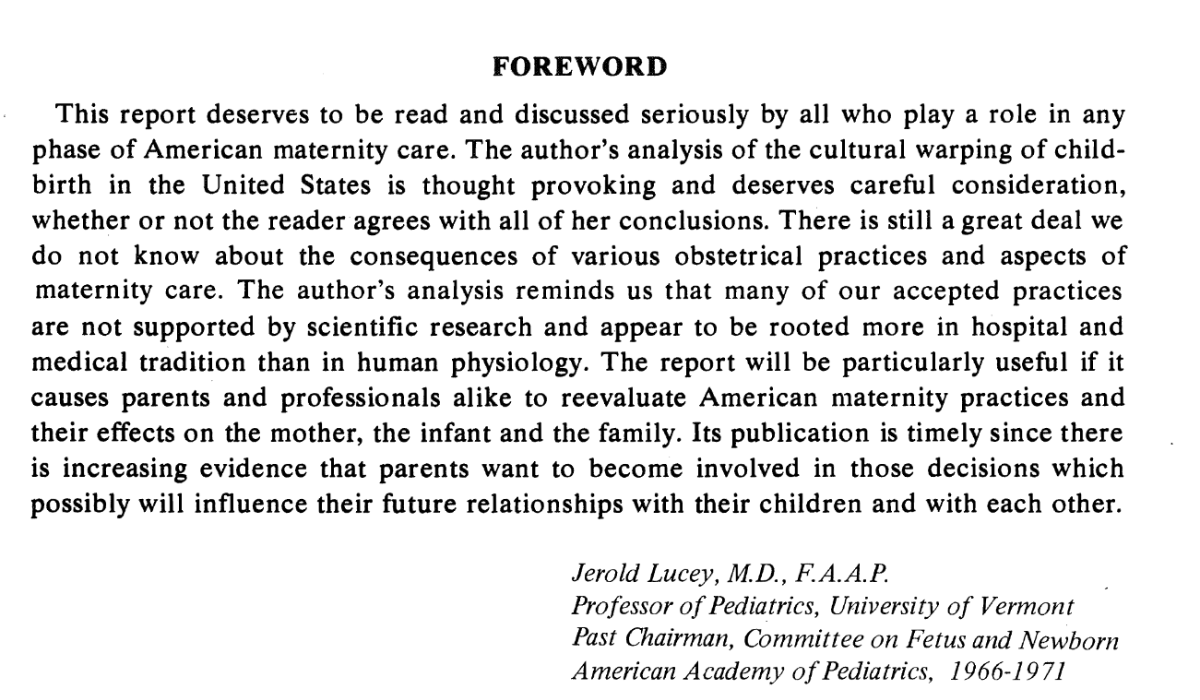
In order for us to pull back from the brink (or claw our way back up the slope), it is imperative that we understand the different ‘ghostly’ forces at play that may have contributed to the shift in the way we think about birth as a society - without us really noticing and without us agreeing it was okay. This is exactly what Jacqueline was explaining to me. It does not matter if you or I agree with everything she says. New or difficult ideas can taste bitter, or be hard to fully understand, but it is vitally important that all ideas are placed into the bigger picture for critical appraisal. This is what education is about, this is what AIMS is about, and this is exactly the point made in the foreword of Doris Haire’s report over half a century ago:
Thank you Doris Haire for awakening me to the way in which culture shapes the experience of birth, and thank you Jacqueline Vejlstrup for continuing to keep me awake.
Author Bio: Alex is the editor for the AIMS journal, a grandmother and great grandmother, and witness to some truly wonderful physiological births. She has close to half a century’s experience as a childbirth educator.
1 Aristotle 384–322 bc Greek philosopher: Diogenes Laertius Lives of Philosophers bk. 5, sect. 18
2 A cultural construct is an idea, practice, or meaning created and shared by a society, not inherent in nature, that shapes how people perceive reality, behave, and interact.
3 Boggs, C. (1976) Gramsci’s Marxism. London: Pluto Press. Cited by: Burke, B. (1999, 2005) 'Antonio Gramsci, schooling and education', the encyclopedia of informal education. http://www.infed.org/thinkers/et-gram.htm
4 Webster - US senator 1782 - 1852 (1837) From: A speech delivered at Niblo's Saloon, in New York, on the 15th of March 1837, cited in Whipple E P (2001) Great Speeches and Orations of Daniel Webster. Frederick, Maryland: Beard Books
5 Curtin M, Savage E, Leahy-Warren P. Humanisation in pregnancy and childbirth: A concept analysis. J Clin Nurs. 2020 May;29(9-10):1744-1757. doi: 10.1111/jocn.15152. Epub 2020 Jan 23. PMID: 31876048.
6 McNamee MJ, Edwards SD. Transhumanism, medical technology and slippery slopes. J Med Ethics. 2006 Sep;32(9):513-8. doi: 10.1136/jme.2005.013789. PMID: 16943331; PMCID: PMC2563415.
Please feel free to download and share a pdf of this article. If you wish to use AIMS copyright material please see aims.org.uk/general/aims-copyright
If you found this article helpful please consider becoming an AIMS member or making a donation to support our work. We are a small charity that accepts no commercial sponsorship, in order to preserve our reputation for providing impartial, evidence-based information.
AIMS supports all maternity service users to navigate the system as it exists, and campaigns for a system which truly meets the needs of all.