Get out there and conference!

ISSN 2516-5852 (Online)

AIMS Journal, 2024, Vol 36, No 3
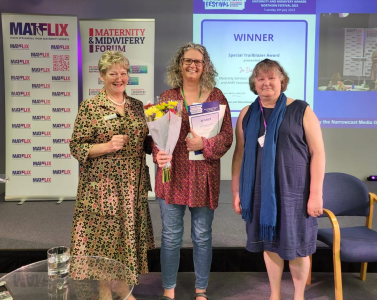
Colour photo of three women - Jo Dagustun in the centre - at a maternity conference. Jo is holding a bunch of flowers and some papers

By Jo Dagustun

AIMS Volunteer, Jo Dagustun, reflects on her recent day out at the Northern Maternity and Midwifery Festival, and encourages others working for maternity service improvement to give this series of free conferences a go.

With my free ticket booked for this event, I woke up last week to a lovely sunny day, recalled how unreliable our local train service is, and for a few minutes - I will be honest! - wondered whether it was really worth travelling to the conference. After all, I could watch quite a bit of it from my kitchen table, via the livestream, and other sessions would be on catch-up. But I’m so glad that I attended the event in person, and I’ve written this article to tell you why. Maybe it will tempt you to attend one of these festivals in your region?

But first, I want to put this activity in context. I am a part-time AIMS volunteer, and I have a lot of flexibility in how I use my time.

Moreover, whilst there is - quite rightly - much attention focussed on continuing professional development (CPD) for healthcare professionals, I’m also on a bit of a mission to see 3rd sector/service user maternity service improvement advocates prioritise their own CPD, to help us become ever more effective advocates for improvement.

So back to the conference and why I found it useful for my AIMS work to attend in person:

  • The keynotes. I really appreciated the quality of the keynotes last week. I don’t underestimate the power of simply being in the room when a relevant and hard-hitting keynote is delivered. I am sure that being there improves my learning and recall; the important messages seem to stick in my mind far better than if I watch such sessions on screen. It’s also wonderful to listen to speakers in person, especially if you’ve been admiring their work from afar (e.g. via papers, books or social media). And of course, there is also the possibility of asking questions or making observations in the plenary session - if you’re brave enough. Another option is to hang around and ask your question privately, if the queue to do this isn’t too long! Last week, the plenary sessions included Benash Nazmeen on ‘working with language barriers’ (including an excellent briefing on further work needed to ensure high quality interpretation services for all who might benefit from them), Manisha Sheth on ‘culturally safe maternity care’ (which included a challenge to the audience: have you read The Invisible Report yet?), and Kathryn Gutteridge on ‘perinatal mental health’ (with a moving and thought-provoking focus on sexual abuse). All of these were fascinating, challenging and highly thought-provoking sessions, with plenty of time for interesting questions and reflections from the audience.

  • The opportunity for fruitful conversation. This one’s a bit of a lottery, perhaps: what’s the likelihood that you’ll meet someone with whom you have something in common and with whom you can have a really useful conversation? The one certainty is that this won’t happen if you’re not there. Last week I identified a shared interest with a speaker - an issue that coincidentally had been on my desk just the day before - and we were able to have a really good chat (that’s the technical term for exchange of views and information), with plans for follow up. I would never have had that conversation - or made that new connection - if I’d been sitting at home.

  • Expanding horizons. There are things I know about the maternity services and things I don’t, but also plenty that I don’t even know I don’t know. This again is where these festivals come up trumps. If I’d been at home, I might have skipped some of the ‘less relevant looking’ sessions. But physically being in the conference zone, this is far less tempting. So I sat in on some presentations that - frankly - I didn’t think would be of any interest to me. But I should have known better: of course, I soon discovered they were. The conference offers the opportunity to learn about whole new areas of the maternity services, which as well as being interesting in themselves, really helps to put whatever you’re working on into perspective and encourages a more holistic way of thinking about maternity improvement. My mind was buzzing, and I came away with a whole new appreciation of the importance and professionalism of our midwifery educators in particular, as well as a renewed commitment to professional curiosity.

I am grateful to have sat in on presentations on such a wide variety of work, including new topics and methods for teaching and learning (‘a memory making workshop to increase the self-reported confidence of student midwives’ - thank you Rebecca), student experience (‘Navigating Disparities: a Student Midwife’s experiences and perspectives on maternity inequalities for Black women in the UK’ - thank you Olga), and - to end the day - a tale of the start of new research into a potential birth-room therapy (‘cold therapy methods in labour and birth - thank you Emily). I also learnt more about Baby Buddy (a service-user facing information and support app developed by Best Beginnings - thank you Mari) and work underway to better understand how to reduce pre-eclampsia (where recruitment is now underway for the Starship Study - thank you Lucy).

  • Building connection. Last but not least, the Festival was a great opportunity to prioritise catching up, face-to-face, with some AIMS and Maternity Continuity Network colleagues; in this era of widespread homeworking, this possibility is a real treat in itself!

Cost of the day: my pro-bono time plus expenses (of just £7.40 for my train fare) charged to AIMS. I call this a win! Not all of my outings are as cheap for AIMS. In that context, I want to add in a heartfelt reminder to please support AIMS if you can, as our Campaigns Team costs do mount up. Information on how to become an AIMS member and how to donate can be found on our website: AIMS For a better birth.

I hope that I’ve whetted your appetite a little. Why not go to your next local festival (other types of conferences are available) with curiosity and an open mind, and see what you can make of it? I’d also love to know what your favourite low-cost maternity conference is: let me know!

Thanks as ever to the Maternity and Midwifery Forum for facilitating these conference spaces. You can find out about their programme of regional festivals here: Events – Maternity & Midwifery Forum (maternityandmidwifery.co.uk).

DOI: I am not in any way financially linked to the Maternity and Midwifery Festival team, nor have I any other known conflicts of interest to report. I did win a Festival award last year, however, as per the accompanying photo!


The AIMS Journal spearheads discussions about change and development in the maternity services..

AIMS Journal articles on the website go back to 1960, offering an important historical record of maternity issues over the past 60 years. Please check the date of the article because the situation that it discusses may have changed since it was published. We are also very aware that the language used in many articles may not be the language that AIMS would use today.

To contact the editors, please email: journal@aims.org.uk

We make the AIMS Journal freely available so that as many people as possible can benefit from the articles. If you found this article interesting please consider supporting us by becoming an AIMS member or making a donation. We are a small charity that accepts no commercial sponsorship, in order to preserve our reputation for providing impartial, evidence-based information.

JOIN AIMS

MAKE A DONATION

Buy AIMS a Coffee with Ko-Fi

AIMS supports all maternity service users to navigate the system as it exists, and campaigns for a system which truly meets the needs of all.

Latest Content

Journal

« »

Women, Pregnancy and Artificial Int…

AIMS Journal, 2025, Vol 37, No 4 By Christopher Yau, Nuffield Department for Women’s & Reproductive Health, University of Oxford on behalf of the MUM-PREDICT and OPTIMAL…

Read more

What has the AIMS Campaigns Team be…

AIMS Journal, 2025, Vol 37, No 4 What has the AIMS Campaigns Team been up to this quarter? By The AIMS Campaigns Team Published written outputs: 19th August: Peer review…

Read more

Conflicting advice for pregnant wom…

AIMS Journal, 2025, Vol 37, No 4 Researchers Siang Ing Lee and Ngawai Moss report on the qualitative study they conducted to inform a core outcome set for studies of preg…

Read more

Events

« »

AIMS Workshop: Wellbeing

AIMS is delighted to be hosting a Wellbeing workshop delivered by Ruth Weston , veteran birth activist, AIMS member and author of 'Born Stroppy Make Change Happen'. This…

Read more

Threads of Protest: Human Rights in…

It combines the talents and knowledge of members of the public, artists, professional crocheters and charitable organisations to create crochet artwork designed to challe…

Read more

AIMS Workshop: The Foundation Stone…

Join us for one of our series of interactive online AIMS workshops " The Foundation Stones for Supporting the Physiological Process in Pregnancy and Birth ". Please follo…

Read more

Latest Campaigns

« »

AIMS, ARM and Birthrights Open Lett…

AIMS (Association for Improvements in the Maternity Services), ARM (the Association of Radical Midwives) and Birthrights are jointly calling for action in the light of th…

Read more

NICE Intrapartum Care - Water birth…

AIMS submitted comments on the draft NICE Guideline update on Intrapartum care for Water birth: second stage of labour (August 2025). You can read the the draft here You…

Read more

AIMS Responds to NHS 10 Year Workfo…

NHS workforce planning needs to be fit for the maternity service The current system of NHS workforce planning in England is not delivering a safe, personalised and equita…

Read more