
To read or download this Journal in a magazine format on ISSUU, please click here
AIMS Journal, 2020, Vol 32, No 2
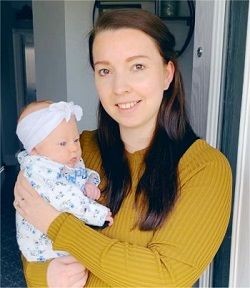
By Polly Warr
My daughter, Everly, was born on Monday the 23rd of March at 7.57pm in the midwife led unit at the Norfolk and Norwich hospital.
This was the day that lockdown was announced for the whole of the country. Everyone had to stay home and no one was allowed in your home, which meant that our friends and family wouldn’t be able to meet her, give her a cuddle or smell that new-born smell she had.
I was lucky enough to have had a low risk pregnancy and although we had a very long latent phase, active labour was fairly straight forward with Everly being born in the birthing pool and just needing a little help when she was born with her breathing. Luckily, the fantastic midwives were perfect and we quickly heard that heart-warming cry that all parents long to hear.
I cannot fault our care whilst at the Norfolk and Norwich hospital. Luckily, Covid-19 had not really affected my care. Apart from the extra bit of cleaning and PPE there were no staff shortages and we had excellent care throughout. Even with the pandemic going on around us the midwives made us feel safe and did everything they could to ensure everything was as normal as possible.
After Everly was born, the midwife suggested we stay a little longer after the birth to ensure that we could start to establish breastfeeding before going home. I realise now why she suggested this, and I’m glad we stayed those extra few hours. Everly didn’t take to breastfeeding and found it hard to latch on properly, and although we had support from several midwives with breastfeeding expertise in the hospital at the time, I knew that when we left, the support would be gone. It would just be me, my husband and Everly.
Over the next few days, we continued to struggle with feeding, and it all became very painful both physically and mentally. In normal circumstances I would have called over my Mum for support, to let me know I could get through this difficult time and everything would be OK. Due to Covid-19 I couldn’t do any of those things and in the end we had to call on the already stretched midwives for support as we were worried that Everly wasn’t getting enough to eat.
Luckily the community midwife we spoke to was brilliant and came round to the house that afternoon to offer support to us. It was just what we needed, she watched me feed and realised the positioning of my hands was stopping Everly from moving her head back, meaning her latch was very shallow which was causing the pain. With a simple change of hand position from me, everything seemed to feel better and the breastfeeding journey was able to continue with much less pain and worry.
By the end of the first week we had 4 visits in total from the midwife. Everly was gaining weight and didn’t scream the house down when she had her heel prick test. All was going well. On Everly’s fifth day with us, our last visit from the midwife, we were told we were being discharged and we would not have any more visits from anyone. This began a wave of worry. Would I be able to care for Everly without these visits from midwives, health visitors and my family? Could we be the parents Everly needs without the physical support from others? I knew I would be able to phone the midwife and health visitor if there was a problem, but it was the physical contact with a health professional that I knew I would struggle without.
We didn’t receive a visit from the health visitor and were told that our 6 week check by the doctor wouldn’t take place either. The next contact I would have would be with a nurse when Everly had her 8 week immunisations, and at the time that was 7 weeks away and I wondered how I would get through that time, just myself and my husband. I felt like I needed the reassurance from these people to let me know everything was OK and that Everly was OK. Although I knew deep down that everything was fine, I think hearing those words from a doctor or health visitor would have helped to reduce the number of times I searched for ‘what is wrong with my baby’ when she was crying.
Everly is now 5 weeks old and Covid-19 is still affecting our everyday lives. My husband and I are still the only two people to hold her. Thankfully, technology has meant that our families can see her every day. For us as a family, Covid-19 affected us more emotionally during our postnatal time. To not have the support from family, friends and health professionals, that reassuring hug that you're doing a good job and just someone to hold her so you could finally have that well needed shower. I can’t wait for the day that our families can hold her, and life begins to go back to normal. Everly has a lot of world left to explore and lots of amazing people to meet.
Through our journey of childbirth, the NHS have been brilliant and even with a worldwide pandemic happening around them, they always put me first, no matter what. Thank you.
Please feel free to download and share a pdf of this article. If you wish to use AIMS copyright material please see aims.org.uk/general/aims-copyright
If you found this article helpful please consider becoming an AIMS member or making a donation to support our work. We are a small charity that accepts no commercial sponsorship, in order to preserve our reputation for providing impartial, evidence-based information.
AIMS supports all maternity service users to navigate the system as it exists, and campaigns for a system which truly meets the needs of all.