
AIMS Journal, 2026, Vol 38, No 2
By Tamara Blakemore
I’m a birth artist, and apparently I’m here to talk about the sovereignty of the body, which feels slightly ironic because writing about it feels far less natural than painting it. This piece has probably been edited a thousand times already. I would much rather communicate this through paint and scribbles. With paint I can more easily describe how sovereignty looks to me, how it fills a birth room, how it clings to the walls, how it changes the air. How a mother holding her newborn for the first time looks like swirls travelling inwards towards her chest, and how the rest of the room blurs. How it feels almost uber trippy to stand inside it.
My art practice didn’t begin with a mission statement. It began with a biro in my pocket and a quiet shift at Treliske, the Royal Cornwall Hospital in Truro. A woman labouring. Me standing there feeling the intensity of it and not quite knowing where to put myself. So I drew. Not strategically and neither beautifully. Just quickly. Lines trying to keep up with what was happening in front of me, the curve of her spine, the way her partner’s hand hovered before finally settling on her shoulder, the particular stillness that comes right before a surge.
I hadn’t planned to become ‘a birth artist’. I was just trying to process what I was witnessing. When I handed the sketch to the family afterwards, the room shifted. It wasn’t about admiration for the drawing. It was about recognition. About someone having seen what had just happened.
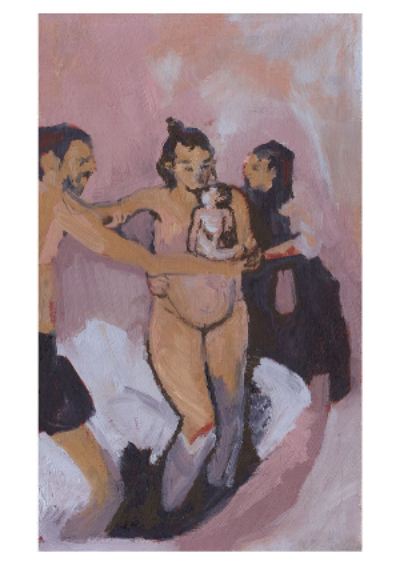 Get out of the Birth Pool
After that a social media post about my passion for drawing more births, the messages started arriving.
It wasn’t a dramatic flood. Just slowly. Women began asking, sometimes tentatively, if I would draw their births. And what they brought me wasn’t just candlelit homebirths and water pools glowing softly in the corner; it was c-sections too with surgical drapes, wires and emergency buzzers. Instagram messages that began with, “I don’t know if this is something you do…”
Miscarriages. Stillbirths. Early neonatal loss. Caesareans, planned and unplanned. Births that didn’t look like empowerment quotes.
Those messages made me pause, because suddenly, this wasn’t about creating something beautiful, it was about holding stories that had grit. Stories women weren’t sure they were allowed to feel proud of. I recognised that feeling immediately.
It took me back to my own second birth, when I had a postpartum haemorrhage. For years I carried something close to shame about it. Shame might sound dramatic, but it’s the closest word. It didn’t look how I thought it should look. I had approached it with a ‘go with the flow’ energy, but underneath that, was fear. A heavy reliance on the system to save me, not to partner with me, but to rescue me. And although an early induction saved my baby potentially from infection, and whilst I am deeply grateful, I didn’t feel sovereign. I wasn’t prepared for how a highly medicalised birth would feel. It felt unfamiliar which made me feel small.
Listening to other women, especially those telling me about trauma and loss, shifted something in me. I began to see that sovereignty doesn’t only live in serene births. Sovereignty can also live within a state of emergency and by telling the story afterwards instead of burying it.
Over time, I’ve become fascinated not only by the physical act of birth, but by the atmosphere that emerges when a woman births in her power. It’s difficult to describe without sounding slightly mystical. But it’s real. I’ve seen it in hospitals, in operating theatres, in living rooms, in my own bedroom.
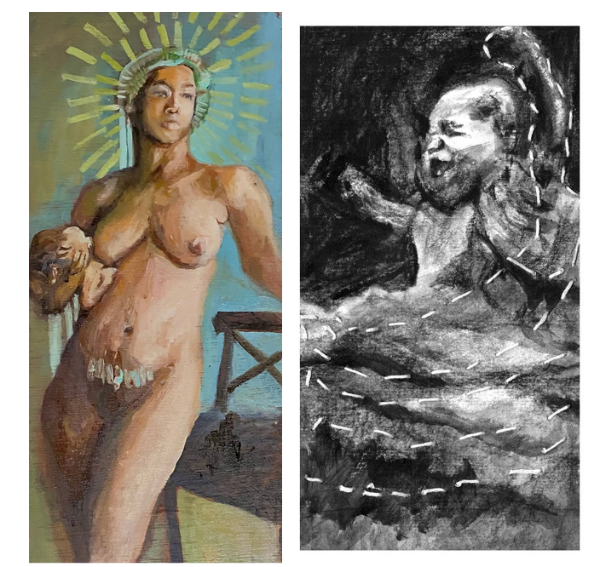
Standing C Section Mother and Stitches in Victory
I once stood in a c-section recovery room, still bright, still clinical, when the father began to sing. He was a trained opera singer. No one prompted him. He just started. His voice filled that sterile space in a way that almost bent it. I remember seeing swirls. I often do when emotion thickens in a room, like the sound itself was moving in curves. It wrapped around the baby, around the mother still trembling slightly from surgery. For a moment, the theatre lights and the antiseptic air felt secondary. This is what I would call ‘sovereign’.
Not because it avoided intervention. Not because it fitted anyone’s ideal of birth. But because something deeply human took up space where it easily could have been swallowed by procedure.
Birth, to me, is one of the most profound expressions of bodily sovereignty. A literal human birthing another literal human. When you really sit with that, it’s wild. Completely wild. I sometimes wonder whether we’ve become so accustomed to the medical framing of birth that we forget how extraordinary it is.
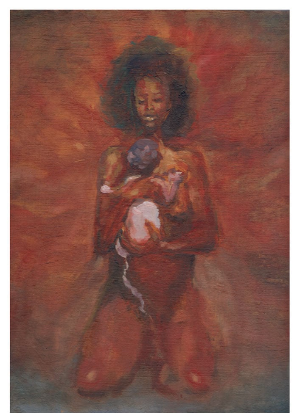 Delayed Cord Clamping
We talk about dilation charts and risk percentages, and those things matter. They do. But we talk less about the internal authority that rises within a woman when she claims her body as her own. Or when she chooses intervention not from panic, but from grounded decision.
I felt that grounding most clearly in my homebirth. I had prepared my bedroom carefully. That was the plan. But when labour intensified, I found myself moving instinctively to the landing outside my boys’ room. There are no windows there. Just a chair and a narrow strip of space. It was broad daylight. I wasn’t thinking, “Ah yes, darkness supports oxytocin.” I know that logically. But I wasn’t in logic.
My body simply took me there. I swayed. I leaned over the chair. I breathed in a way that was automatic. It wasn’t aesthetic. It wasn’t part of the birth plan. But it felt deeply right. That also felt sovereign.
Which makes me think sovereignty isn’t really about the environment alone. It’s something quieter and deeper. A dance between autonomy, intuition, and feeling safe enough to listen inward.
I once Googled ‘sovereignty’ and some slightly irritating AI intervention I didn’t ask for popped up underneath my search bar. I was given a long explanation about supreme authority and governance. It’s a political word. Nations. Borders and Control.
But in birth, it doesn’t feel like control to me. It feels like alignment. It feels like a woman closing her eyes before answering a question. It feels like her saying yes and meaning it. Or no and meaning that too.
In the birth world, we use the BRAIN tool. Benefits, Risks, Alternatives, Intuition, Do Nothing. I value it. I really do. But I can’t help noticing that intuition sits fourth. I suppose something had to be fourth. Still, poetically, it feels like the quiet one at the end.
Intuition fascinates me. Where does it come from? Is it ancestral? Learned? Subconscious pattern recognition? Am I wary of a bright red mushroom in the woods because of deep evolutionary memory, or because someone once told me they’re poisonous?
As an artist, I have to believe there is an inner knowing that transcends pure logic. When I paint, I don’t analyse every stroke. I feel it. My body moves before my brain explains. That, to me, is intuition. Not irrational and neither reckless.
During one pregnancy, my obstetrician carefully outlined why a homebirth might not have been advisable for me. She gave me data, risk ratios, professional guidance. I listened to all of it. Then when I prodded for a personal opinion she said, “We simply don’t have a crystal ball.”
That sentence steadied me more than the statistics. After sitting with everything, a few days later I heard myself say, “Thank you for your help the other day. I think I’m going to be fine. At the moment I feel like it’s going to be ok.” I surprised myself. It sounded almost naïve out loud. But she didn’t dismiss me. Instead, she told me about a woman who had insisted something was wrong about her pregnancy only a week ago, and the woman had been right despite clinical evidence pointing to her being “low risk”.
That conversation has stayed with me. It wasn’t rebellion. It wasn’t blind faith. It was integration. Research and instinct sitting side by side.
Sovereignty, for me, isn’t loud. It’s subtle. It can be the grip of a hand on a bedsheet.
It’s a bereaved mother choosing to hold her baby for longer. It’s opera in the recovery room. And it’s me swaying in a darkened landing that I didn’t plan to use.
It’s not about doing birth ‘right’. It’s about doing it honestly. And that’s why I find it such a beautiful subject matter to paint.
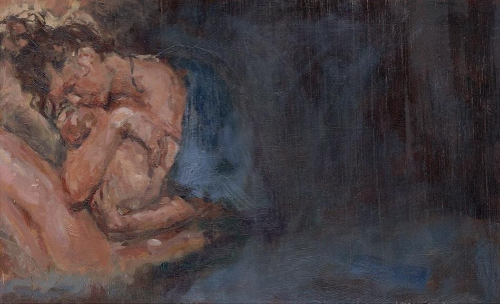
Just Us
Author Bio: Tamara is a birth, breastfeeding and baby-loss artist, and also works as a maternity assistant, essentially an extra pair of hands for midwives. Her days are spent weighing babies, taking bloods, offering breastfeeding support, and, of course, making endless tea and toast. She is a mum of three who squeezes her family (and a lot of love) into a small cottage in Cornwall, where she juggles motherhood with running her art business.
Please feel free to download and share a pdf of this article. If you wish to use AIMS copyright material please see aims.org.uk/general/aims-copyright
If you found this article helpful please consider becoming an AIMS member or making a donation to support our work. We are a small charity that accepts no commercial sponsorship, in order to preserve our reputation for providing impartial, evidence-based information.
AIMS supports all maternity service users to navigate the system as it exists, and campaigns for a system which truly meets the needs of all.