AIMS Journal, 2026, Vol 38, No 2

Inanna, Sumerian Queen of Heaven and Earth.1
By Alex Smith and Dr Kirsten Small
A sovereign decision, in keeping with the context of this quarter’s journal theme, is one made by a pregnant or labouring woman independently, on her own behalf, free from undue pressure or coercion.
I have just finished reading Kirsten Small’s book, ‘Monitoring your baby in labour’.2 Kirsten is a retired obstetrician with a specialist knowledge of CTG (cardiotocography) monitoring. CTG monitoring involves two bands being placed around the mother’s belly, one measuring her contractions and the other measuring the baby’s heart rate. Over half of labouring women in the UK will be monitored in this way. Many find it restrictive and most won’t have known they had a choice.3
Close to the beginning of her book Kirsten writes:
“Here’s the main point this book is going to make - CTG monitoring is nonsense!”
She goes on to set out the evidence to support that statement - not just for women regarded as ‘low risk’, but also for women labelled as ‘high risk’ - helping the reader to weigh the benefits and risks of CTG monitoring for themselves. If you haven’t got time to read the whole book, visit her website to find out more.
In a way, anything that is done to a woman in the course of her maternity care has been her sovereign decision because, legally, nothing could have been done without her willing consent.
In reality, this is not the story she will tell. She is likely to say that she ‘had to have’ an induction that she didn’t want, that she ‘had to have’ a vaginal examination she had hoped to avoid, and that she ‘had to have’ CTG monitoring even though she didn’t know there was a valid alternative. She will have asked if these things were really necessary, and she will have been told they were. She may have believed that a midwife or doctor would never suggest a course of action unless it was evidence-based and absolutely necessary - and that it would be foolhardy to choose something else. Kirsten’s book shows very clearly that this is not the case for CTG monitoring.
But what if the woman knows that the thing she is being pressured to accept is nonsense and is unlikely to improve the outcome yet carries a real potential for harm? What if she has read Kirsten Small’s book? She will still require the courage of her convictions if she wants to buck the system and choose intermittent auscultation. Exercising sovereignty in decision-making can too often feel like a fight.4
Kirsten dedicates several pages of guidance on how to arrive at a decision about monitoring and then on how to communicate that decision in a way that will be respected by the midwife and doctor. With her permission I have selected short passages because Kirten’s own words explain this perfectly.
Many women have grown up believing that they cannot influence the course of labour. To protect themselves from disappointment they talk in terms of “going with the flow”.
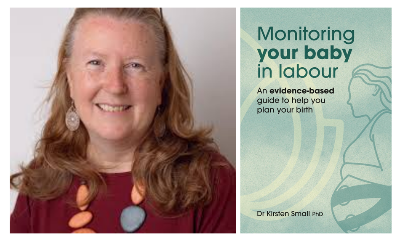
Kirsten Small
In her book Kirsten writes:
“Going with the flow” can seem like the easiest way to negotiate maternity care. But when it comes to fetal monitoring in labour, the direction of that flow is towards a lack of choice, increasingly intense levels of surveillance, and more intervention.
If that’s not what you want, you need to be prepared to take action to go against the direction of the flow. This is your body, your baby, and your birth, and you aren’t going to give birth very often, or possibly ever again. So – commit to doing whatever you need to do to make your birth a positive experience.”
“The key to getting what you want is to communicate what you have decided, not ask for permission.”
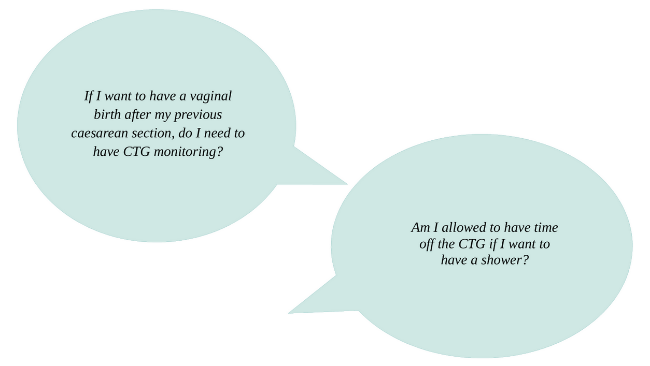
“Consider what will most likely happen if you say things like:
These statements assume the person who has the authority to make this decision is the maternity professional, not you. These questions show the maternity professional that you believe you need their permission to do what you want in relation to fetal monitoring. Yet, this isn’t the case.”
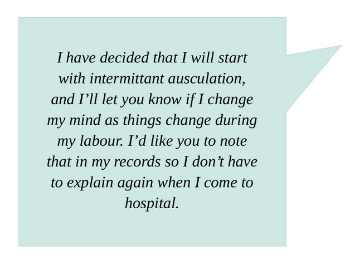
“ Instead…consider the impact of saying:
Statements like this not only communicate your decision, but your awareness that you are the decision-maker. It is important to be really clear in your communication that this is you telling them what you have decided, not you wanting to open up a discussion about your choices (unless you actually want to because you want more information).”
Kirsten advises the mother to:
“Practice making confident statements about your plans for birth until you can do it comfortably. Stand in front of a mirror, or do it with another person, until you can say it without feeling weird. When you show you are clear about what you have decided, it makes it easier for maternity professionals to recognise your decision is a decision, not an invitation to talk you into doing what they want you to do instead.”
Kirsten then addresses the likelihood that the mother will encounter resistance:
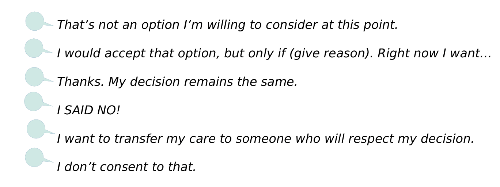
“I’d love to be able to promise you that if you do the things I have already suggested, then your maternity professional will respect your decision and support you by making it happen without fuss. There is a chance that they will push back and try to exert control to get you to do what they have decided you should have. Here are some statements you can try if this happens. Having your support person repeat the same statement, preceded by “She said-“ can help too.”
Kirsten goes on to explain that if you actively want an intervention that usually includes the use of CTG, it may be more difficult to stand your ground:
“Induction of labour and the use of an epidural for pain management are the two examples that come to mind for me. While you can insist that you will have intermittent auscultation, the professional might refuse to go ahead with the intervention if CTG monitoring is considered part of the deal. You will need to decide whether to go ahead with the intervention with CTG monitoring, or continue with intermittent auscultation and not have the intervention.”
Women who call the AIMS helpline for support in their decision-making often assume that they have to convince the midwife and doctor by explaining the rationale for their decision and by backing it up with evidence. They often talk about compromises that will keep the midwife or doctor ‘happy’. Kirsten writes:
“Two things that are not your job: First, you don’t need to explain to your maternity professional why you made your choice, or back your decisions up with evidence, if you don’t want to.”
“And second, it isn’t your job to manage your maternity professional’s emotional response to your decision. [...] If you find yourself stuck in a cycle of worry about telling them your decision, you may find it helpful to remind yourself that how they respond emotionally is out of your control and has nothing to do with you.”
“Your job is to decide. Their job is to respect your decision.”
Kirsten recognises that some women find it very hard to stand their ground. They may assume that it is the midwife’s job to be the good communicator and to make the decisions. She says:
“Making and communicating a decision about fetal monitoring should not be difficult. Yet it sometimes can be. If you experience this, know that this is a symptom of a maternity system that is not functioning well. We should have a maternity system where professionals always respect and listen to women, provide recommendations based on evidence from well conducted research, and support women’s decisions. Instead, we have a system where guideline recommendations about fetal monitoring don’t match up with evidence and where it is easier for maternity professionals if they can get women to do what the guideline says.
To repeat:
“We have a system where guideline recommendations about fetal monitoring don’t match up with evidence.”
Kirsten concludes the section on decision-making by considering the women who are less able to advocate for themselves - women who have their sovereignty denied - and, very close to AIMS heart, with a rally cry for would-be birth activists to help push for a better maternity system.
“Sometimes getting what you want from your maternity care happens by pure luck. At other times it is because you are strong, well educated, well supported, and you didn’t give up until you got what was best for you. While it is awesome that some women can do that for themselves, it also bothers me. Women who don’t speak English, can’t read, are socially isolated, or have been traumatised in the past might be unable to stand up for themselves in this way. These women shouldn’t get worse care than persistent, strong, educated, supported women, but they sometimes do. We know there are worse outcomes for disempowered and marginalised women from national reports on the outcomes of maternity care in all our high-income countries (like the most recent Saving Lives, Improving Mother’s Care report from the UK, Felker et al., 2024). I, like many others working in maternity research and education, continue to push for change so respectful, evidence-based approaches to care are the standard. If you want to contribute, there are organisations and social media-based groups that you can join to help push for a better maternity system.”
“The type of fetal heart rate monitoring used during your labour and birth is your decision.”
Editor’s note: If you’re passionate about evidence based maternity care, consider joining AIMS.
Author Bios:
Dr Kirsten Small is a retired obstetrician, a researcher, and a writer. As an internationally recognised expert on fetal monitoring, she generously shares what she knows through her Birth Small Talk blog. Kirsten's vision is to promote and protect respectful maternity care for women, babies, families, and their care providers through education and research. She lives on the Sunshine Coast of Australia.
Alex Smith is the editor of the AIMS journal and volunteers on the AIMS helpline.
1 Illustration taken from “Myths and Legends of Babylonia and Assyria” by Lewis Spence (1916) Public domain.
3 Levett K, Fox D, Bamhare P. et al. (2024) Do women have a choice when it comes to fetal monitoring? Perceptions of information provided and choice of fetal monitoring in Australia: A national survey. Women and Birth, 37. https://www.sciencedirect.com/science/article/pii/S187151922400297X
4 Hussain I M., Buchanan K., Sweet L., Bayes S. (2025) Women’s experiences of declining recommended or routine maternity care: A systematic review. Women and Birth, Volume 38, Issue 6. https://www.sciencedirect.com/science/article/pii/S1871519225002574?via%3Dihub
Please feel free to download and share a pdf of this article. If you wish to use AIMS copyright material please see aims.org.uk/general/aims-copyright
If you found this article helpful please consider becoming an AIMS member or making a donation to support our work. We are a small charity that accepts no commercial sponsorship, in order to preserve our reputation for providing impartial, evidence-based information.
AIMS supports all maternity service users to navigate the system as it exists, and campaigns for a system which truly meets the needs of all.