
AIMS Journal, 2024, Vol 36, No 4
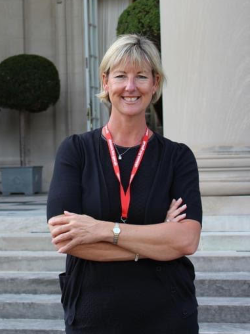
By Lesley Weatherson
The current provision for women and birthing people who are deaf within the maternity setting is far from acceptable. There seems very little passion for change despite the efforts of many. Midwives want high quality care for all those in their care and communication is at the heart of this. Deaf women and birthing people want to establish a rapport with their midwives, make informed decisions about their pregnancy and delivery. Communication breakdown often prevents a truly holistic birthing experience.
The British Sign Language (BSL) Act 2022[1] means that there is now a legal duty to provide the correct communication support for deaf British Sign Language users in the UK but the Act is either being ignored, is not understood or is unknown. This affects deaf and deafblind people. Deaf women avoid seeking care, have a lack of access to health information and indeed, healthcare providers, including midwives, have a lack of deaf awareness. For deaf women, during pregnancy, birth and postnatal, this can mean having longer hospital stays and more complex needs in both the hospital and community setting.[2]
The introduction of the Accessible Information Standard[3] advised health professionals to ask about and document each patient’s preferred communication needs.
From 1 August 2016 onwards, all organisations that provide NHS care and/or publicly-funded adult social care are legally required to follow the Accessible Information Standard. The Standard sets out a specific, consistent approach to identifying, recording, flagging, sharing and meeting the information and communication support needs of patients, service users, carers and parents with a disability, impairment or sensory loss.
One hoped this would see a real shift in the provision of the correct communication support within medical services. I wrote an article for The Limping Chicken back in March, 2019 hoping provision of communication for deaf and deafblind parents would have changed; sadly, not enough has improved.
The Sick of It report, published by Sign Health in 2014, shows that:
Deaf people are suffering from preventable and potentially life-threatening illnesses due to access limitations, misdiagnosis, and poor treatment.
Misdiagnosis and poor treatments are costing the NHS millions each year. According to the 2007 Saving Lives report, twenty percent of maternal deaths between 2003–2005 were of women who had late or infrequent antenatal care.[4]
The NICE Antenatal guidelines fail to mention recommendations for the care of deaf women only referencing how information should be imparted.
1.1.2 “Ensure that the materials are available in different languages or formats such as digital, printed, braille or Easy Read”
It doesn’t mention BSL.
I have undertaken numerous training activities for both British Sign Language (BSL) interpreters and directly with colleagues and midwives, and lectured to many senior midwives regarding the importance for everyone of understanding their own health. However, effective communication and the rights of access to health information for deaf people is still below an acceptable standard.
Language agencies who are responsible for filling interpreting requests don’t always understand the differing needs of deaf and deafblind people so often that the wrong communication professional attends, or none at all. The large spoken language agencies on the national framework do not always understand the various cultural and communication needs of deaf and deafblind people. I know this from personal experience as I am a qualified BSL interpreter, lipspeaker and deaf blind communicator and often turn up for a booking requiring one skill after being booked professionally, for another.
Language agencies making requests do not always give out the name of the deaf person (correctly so), or the ward/department for the booking, stating that GDPR prevents this being allowed. This causes problems as interpreters may simply delete the request citing lack of information, contact the agency only to be told there isn’t any more information that can be shared, or accept the booking not knowing if they are the best person for it. Female interpreters can end up on male urology wards and male interpreters on gynae wards; all equally qualified to do the job but not necessarily acceptable for the deaf person. If the woman refuses to use the attending professional, she may be considered awkward or problematic and this may affect further support and the midwife/patient relationship. If she continues with the appointment she may not engage, may miss important information or both. This has to change.
Frameworks don’t work in my opinion, and in 2015 I signed the open letter to Francis Maude MP (2015) as part of the campaign to Scrap The Framework. However, little has changed and it remains that deaf people are not always getting the support they need and interpreters are still experiencing poor terms and refusing to work for some agencies, thus reducing the availability of qualified and adequately trained professionals.
Practical changes must be made. Policies must include a mandate for the correct communication support professionals to be booked for all appointments with the responsibility lying with the health care professionals. Deaf parents must have alternative ways to contact health care services. This is necessary and must include access to other support services such as those for people requiring breastfeeding support, or for people with unplanned pregnancies, and also to support services for victims of rape, domestic violence and so forth.
Once seated inside the hospital, deaf women or birthing people can wait, unseen, for extended periods of time as they are unable to hear their name or number being called. This leads to frustration and unnecessary delays in being assessed, and this is particularly serious when there is a medical emergency such as lack of fetal movements or vaginal bleeding. Even when they are seen on time, if there isn’t an interpreter present the appointment may be abandoned. This is particularly so if BSL is the first language of the parents as the midwife or doctor will not be able to ask questions of the deaf parents, nor understand anything signed to them by the deaf parents.
Ultrasound scans are held in dimly lit rooms. Lipreading is very difficult and tiring especially in poor light. I take a doll with me when supporting deaf/deafblind parents so they can feel the part of the body that the radiographer is seeing on the screen and giving information about, such as the heart chambers or the kidneys and whether it’s a girl or a boy, for example. This is a particularly anxious time for the parents as the news isn’t always positive or welcomed.
Well-meaning hospital staff who know some basic sign language try to make do. This often results in miscommunication and misinformation. Errors in previous medical histories may be recorded as fact and important information is never truly conveyed. This can lead to poor outcomes for mother and baby. The correct communication professional must be used.
Deaf awareness is clearly lacking in many obstetric units across the UK and deaf parents are not receiving the same care as hearing parents.
For example, here is a deaf woman’s experience during the pandemic (expecting her 5th baby):
Many parts of this avoidable scenario were preventable. Would a hearing woman have faced the same barriers?
Despite the BSL Act 2022, information available online, in written formats, and verbal instructions or advice, is often not understood by deaf parents as English isn’t their first language. For deaf parents from a non-English speaking family or country, a foreign language sign language interpreter may be needed,[5] but where does one find such support? This often means that families are relied upon to interpret throughout the maternity term leaving no autonomy for the deaf parents; they will only receive the information given by the translator and this may not be accurate; intentionally so or otherwise.
An article from the British Medical Journal in 2020[6] explains:
A family member may also give you their own version of events, and their emphasis may skew the whole consultation. It can also be difficult to check the veracity of the interpretation. This could lead to a misdiagnosis.
Family members should not be used as non-professional interpreters in consultations.
NHS England, in reference to primary care, states that, ‘The use of an inappropriately trained (or no) interpreter poses risks for both the patient and healthcare provider.’ And further, ‘The error rate of untrained interpreters (including family and friends) may make their use higher risk than not having an interpreter at all.
Those women who are abused or victims of domestic violence would be traumatised further by having the perpetrator inside the hospital room. Deaf women are at twice the risk of being victims of abuse and domestic violence.[7] and need accessible and appropriate support services such as Deaf Hope.[8], [9]
Of course, not all pregnancies go to term. Spontaneous and planned abortion, ectopic pregnancies an so on, mean that support and counselling may be required from very early in the pregnancy. If the medical professionals don’t know how to access support, don’t know how to ask for gender specific interpreters, or believe they can make do with pen and paper, then communication will never be effective and deaf parents will almost certainly not receive parity.
We need to see structural changes in the way we teach midwives and doctors so that the considerations regarding communication are encompassed in learning from day one. Hospital staff need deaf awareness training on a regular basis and not a token one-off teaching day that is easily forgotten. Deaf people must be involved in this cultural change when midwives and doctors are students. We must strive to make deaf awareness training mandatory, guiding lessons learned into practice so parity with hearing patients becomes the norm. Let’s have patient-centred care, make time to get things right and truly make each and every woman’s experience the best it can be.
To achieve this, I would like to see engagement from the Nursing and Midwifery Council (NMC) and the General Medical Council (GMC), with trusted deaf charities such as the Royal National Institute for Deaf People (RNID) and the British Deaf Association (BDA), communication with professional associations such as the Association of Sign Language Interpreters (ASLI) and the Association of Lipspeakers with Additional Signs (ALAS). Let’s start having those important conversations to really make a difference to deaf women in the maternity setting.
Tips for all health practitioners:
DO:

Author Bio: Lesley Weatherson is a specialist BSL interpreter; lipspeaker; Deafblind communicator/guide; qualified midwife and nurse.
This article first appeared online on the Maternity & Midwifery Forum in September 2022 and is published here with their permission.
[1] Legislation.gov.org (2022) British Sign Language Act 2022. www.legislation.gov.uk/ukpga/2022/34
[2] Luton M., Allan H.T., Kaur H. (2021) Deaf women’s experiences of maternity and primary care: An integrative review, Midwifery, Volume 104, 2022, 103190, ISSN 0266-6138, https://doi.org/10.1016/j.midw.2021.103190.
[3] NHS ENgland (2017) Accessible Information Standard: Making health and social care information accessible
[4] Lewis, G. (2007) The Confidential Enquiry into Maternal and Child Health (CEMACH). Saving mothers’ lives: Reviewing maternal deaths to make motherhood safer—2003-2005. The Seventh Report on Confidential Enquiries into Maternal Deaths in the United Kingdom. CEMACH, London
www.publichealth.hscni.net/sites/default/files/Saving%20Mothers'%20Lives%202003-05%20.pdf
[5] Editor’s note: For example, deaf parents from the Asian community may use Indian Sign Language or Pakistan Sign Language, whereas someone from America may use ASL, which is very different from BSL.
[6] Rimmer A. (2020) Can patients use family members as non-professional interpreters in consultations? BMJ 2020;368:m447. www.bmj.com/content/368/bmj.m447
[7] Crowe T.V. (2021) Intimate Partner Violence in the Deaf Community https://nsuworks.nova.edu/cgi/viewcontent.cgi?article=1287&context=jadara
[8] British Deaf News (2015) DeafHope: A safe harbour for deaf domestic abuse survivors
www.britishdeafnews.co.uk/deafhope-safe-harbour-deaf-domestic-abuse-survivors
[9] DeafHope. www.deaf-hope.org
[10] Editor’s note: All pregnant women, whether hearing or deaf, should understand their different care and treatment options, and that when variations of normal (or actual complications) arise, their decisions to accept or decline treatment will be respected. Consent is only valid in this way. Consent forms must reflect this and must be accessible and understandable to the person consenting.
The AIMS Journal spearheads discussions about change and development in the maternity services..
AIMS Journal articles on the website go back to 1960, offering an important historical record of maternity issues over the past 60 years. Please check the date of the article because the situation that it discusses may have changed since it was published. We are also very aware that the language used in many articles may not be the language that AIMS would use today.
To contact the editors, please email: journal@aims.org.uk
We make the AIMS Journal freely available so that as many people as possible can benefit from the articles. If you found this article interesting please consider supporting us by becoming an AIMS member or making a donation. We are a small charity that accepts no commercial sponsorship, in order to preserve our reputation for providing impartial, evidence-based information.
AIMS supports all maternity service users to navigate the system as it exists, and campaigns for a system which truly meets the needs of all.