
AIMS Journal, 2026, Vol 38, No 2
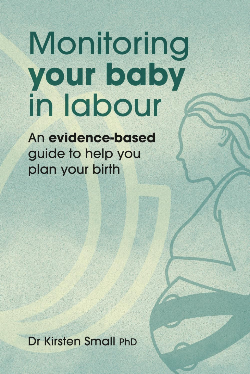
Dr Kirsten Small
Published by BST Press on 27th of January 2026
204 pages
ISBN-10 : 1764171837
ISBN-13 : 978-1764171830
Publisher’s recommended price £15.99
Available to buy from Amazon.
Reviewed by Camille Del Pozo
Dr Kirsten Small is a retired obstetrician and a researcher with a wealth of experience and a special interest in fetal monitoring. During her career she noticed that the way a baby’s heartbeat is monitored during labour is often not presented to women as a choice and women are rarely told about their options. She decided to write this book in order to give women the knowledge and tools to make a truly informed decision about this aspect of their care. Although Kirsten lives and works in Australia, her book is very relevant to anyone living in the UK since both maternity systems bear many similarities.
To summarise this review using Kirsten’s own words:
“Here’s the main point this book is going to make - CTG monitoring is nonsense!”
Listening to the fetal heart is seen as a normal part of the care women receive during labour and rarely given a second thought or questioned, despite the lack of evidence that it improves outcomes for the unborn baby. Women with certain ‘risk factors’, are advised to have their baby’s heartbeat continuously monitored during labour using a cardiotocography (CTG) machine. They are often told that this will enable their care provider to detect if the baby becomes “distressed” due to lack of oxygen during labour, a statement that is not supported by evidence. Women are rarely told about the downsides of continuous CTG monitoring, which are well documented in many studies such as an increased risk of caesarean section and instrumental birth, both of which have a long-term impact on the health of both the mother and the baby.
At a time where interventions in maternity care are at an all-time high, with childbirth being increasingly seen as something that needs to be ‘managed’ rather than a physiological event, Kirsten’s book is a breath of fresh air. Grounded in real evidence, this book takes the reader through the research surrounding fetal monitoring in a way that is accessible and easy to understand. Kirsten discusses the reasons and different ways to monitor an unborn baby’s heartbeat during labour, always referring to the evidence (or lack thereof), with a particular focus on continuous CTG monitoring.
Her analysis of the research is very detailed, she explains the findings as well as the limitations of the studies, with many studies around the use of CTG monitoring dating from the 1970s and 1980s. Kirsten takes into consideration whether the findings are still relevant today and should be applied to the current maternity landscape.
Her determination to empower women to make the decisions that are right for them and their babies is felt throughout the book, with an entire chapter dedicated to decision-making and advocacy. Kisten gives examples of questions women can ask their midwife/care provider as well as the best way to communicate their decision, particularly if it entails declining a certain type/all monitoring. Kirsten also reminds women about their rights during pregnancy and childbirth, which includes the right to decline any aspect of their care.
The book has a section about the future of fetal monitoring, which would probably be of interest to maternity service improvement advocates. However, it did not feel very relevant when the book’s main goal is to give women the information they need to make informed decisions about their care. Instead it would have been informative for Kirsten to explore the reasons why fetal monitoring, particularly continuous CTG monitoring, has become so mainstream, despite an established lack of evidence of its benefits and some well-researched downsides. Discussing the reasoning around the use of CTG, alongside hospital guidelines/national recommendations would have given the reader a valuable insight into the perceived benefits of this type of monitoring, which could be useful for decision-making.
Despite Kirsten’s writing being readable and jargon-free, I was surprised to find that she refers to the unborn baby as a “fetus” throughout the book. This felt like an unfortunate choice of word and very impersonal when taking into consideration her target audience.
Overall this book is a very worthwhile read and I would particularly recommend it to anyone working within maternity.
Reviewer Bio: Camille is an AIMS campaign volunteer and a mother with a background in midwifery. She is passionate about helping women make truly informed decisions.
The AIMS Journal spearheads discussions about change and development in the maternity services.
AIMS Journal articles on the website go back to 1960, offering an important historical record of maternity issues over the past 60 years. Please check the date of the article because the situation that it discusses may have changed since it was published. We are also very aware that the language used in many articles may not be the language that AIMS would use today.
To contact the editors, please email: journal@aims.org.uk
We make the AIMS Journal freely available so that as many people as possible can benefit from the articles. If you found this article interesting please consider supporting us by becoming an AIMS member or making a donation. We are a small charity that accepts no commercial sponsorship, in order to preserve our reputation for providing impartial, evidence-based information.
AIMS supports all maternity service users to navigate the system as it exists, and campaigns for a system which truly meets the needs of all.