
AIMS Journal, 2026, Vol 38, No 2
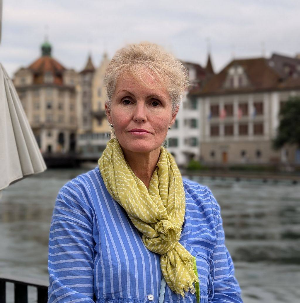
1. Thank you for agreeing to be interviewed by AIMS, Katherine. To start, can you tell us more about what drives your interest in a well-functioning maternity service, and what first attracted you to the idea of becoming a midwife?
In common with many women I became interested in childbirth, maternity care and midwifery when bearing my first child at a very early age. The realisation that this commonplace (certainly in the 1970s) almost universal female experience was the single most profound change in how we are viewed as women and indeed view ourselves, initiated a decades long interest and abiding fascination.
It was clear to me very early, as I went through the intense early years with my older children that I wanted to be involved in helping women navigate the transition into their new selves as mothers. It seemed to me that a successful transition had a foundation in the journey through pregnancy and birth, which, if successfully navigated, was positively life changing. That this would not necessarily relate to the physical and physiological events which may not always be under our own control. It would be facilitated by the support of a professional friend walking through the process with us, allowing us to take on our own strength and autonomy, giving us the best start to our future life as a mother.
On embarking on midwifery training it rapidly became apparent that continuity of carer from a known and trusted midwife was the best way to ensure that the best outcomes for women, babies and their families would be achieved. Countless pieces of research reflect this, especially in cases where there are multiple factors increasing the risk to women and babies. The professional relationship provides advocacy and assistance to investigate the issues, questions and choices the woman feels are important for her, her family, and her situation.
2. You have been a key part of the Association of Radical Midwives (the ARM) for many years, latterly as the ARM National Co-ordinator. Can you tell us more about the ARM and its work?
I was aware that the ambition to achieve the best of care for as many women as possible would require political and societal change, and the revival of continuity of carer as it had existed for many women earlier in the 20th century. I knew of the existence of ARM before I was a midwife, and on giving birth to my 4th child at my first home birth in 1985, I joined soon after. I was eager to enter the new world of strong opinionated women with whom I felt an immediate bond, aiming to attend national meetings and joining the steering group. I applied to be national coordinator in 2012 and continued in that role until September of 2025. The role was devised to be secretarial in the traditional sense but also to represent ARM , maintain links with other organisations, media and politics and to disseminate information.
ARM has never been a large organisation with a maximum of 1500 members as far as I can recall, and of those there has only ever been a relatively small number who were active in working for the organisation. I think ARM’s great strength has been in attracting some extremely innovative, intelligent and dynamic individuals, and not all of these midwives. I particularly honour Margaret Jowitt (1955 - 2025) who wrote and thought extensively on how the uterus and the foetus worked together as birth approached, and during the birth process. She communicated with the very few obstetricians and midwives around the world with a similar interest to extend knowledge of physiology. Margaret was also an excellent editor of our magazine Midwifery Matters. Midwives such as Mary Cronk and Jane Evans developed and revived knowledge around breech birth. The many midwives within and without the NHS who worked to demonstrate the benefits of continuity of carer. A group which started in ARM went on to found the midwives information and research digest “MIDIRS” which was the ultimate research resource in a pre-internet age.
The original “Vision” published by ARM in 1986, and then the New Vision in 2013, both informed the various government documents, Changing Childbirth in 1993 and Better Births in 2016 the latter of which reflected large parts of the New Vision. The overwhelming evidence considered during these investigations, to discover the key to what would fundamentally improve maternity services, was simply good relational continuous care, provided to all women based in their communities with recourse to referral to medical intervention and advice when required.
3. In England this year, we are marking the tenth anniversary of the 2016 Better Births report. In your opinion, what impact did that report have in driving maternity service improvement, and how could it have had more of an impact?
I believe the 2016 “Better Births” initiative was our best chance of improving services, and though there was some resistance and desire to water down real continuity by concentrating on the easier parts of this (antenatal and postnatal care), there was a number of services who took on the challenge in good faith. Unfortunately, where projects weren’t staffed or managed optimally these floundered, as midwives found they were unable to sustain the heavy demands on them of some on call systems. Some private providers also emerged on the market and thrived, until a combination of rapidly rising insurance costs and establishment resistance made it impossible for them to continue.
4. Whilst we are awaiting the outcome of the National Maternity and Neonatal Investigation, being led by Valerie Amos, what do you see as the biggest challenge faced in maternity service improvement work in the UK today?
The mechanisation and medicalisation of childbirth started as the technology became available, first with the unevaluated interventions of ultrasound scanning, continuous CTG monitoring and the increasing use of induction of labour at increasingly early gestations, using prostaglandins and oxytocic drugs. This gradual change, and the belief that physiology could be manipulated without too much negative effect on women and babies, started in the late 20th century but has accelerated in the last 10 years leading to the levels of intervention we now experience in the UK.
The reasons for this are very complex indeed and include societal, demographic and cultural changes which are not directly related to the physical and medical intervention we see. After the first high profile investigation into the failures at Morecambe Bay Trust, by Bill Kirkup in 2015, we have seen further investigation of maternity services by Donna Ockenden and now Baroness Amos. Unfortunately for those of us who are keen to promote the benefits and the mechanisms of physiological birth, these reports so far have been picked up by interested journalists, MPs and activists to “prove” that midwives are engaged in an ideological campaign to force “normal” birth upon women, endangering them and their babies. This seems anomalous when the rates of induction and caesarean section have grown so high, and when there is no distinction made between what midwives would describe as physiological birth and any vaginal birth by whatever means and with numerous medical interventions.
Around the same time, the recognition that stillbirth and neonatal loss rates were not as good in the UK as in what are deemed comparable countries lead to a decision, made by local maternity systems countrywide, to try to improve these outcomes by avoiding the death of babies in late and post dates pregnancy by early detection of those at risk. This drive has been implemented by vigorously assessing and screening the growth of babies in the uterus, by much more intensive programmes of ultrasound scanning than prescribed for a large proportion of the pregnant population, based on their underlying risk. The Perinatal Institute proposed to monitor how maternity services responded and achieved targets of detecting which babies might be at risk and ensuring that these babies were born before they were at risk of being lost in late pregnancy.
We were sceptical that such interventions would have any significant effect on the stillbirth and neonatal death rate. Instead, we feared that they would significantly increase unnecessary medical interventions in childbirth; maternal and infant morbidity; and stress on maternity services, leading to a less comfortable and pleasant experience of care for women and increased stress and burnout for midwives. We now have the statistical evidence to demonstrate that this is in fact what has happened. There is little improvement in the stillbirth and neonatal death rate, or in rates of maternal deaths, in fact maternal deaths have risen and neonatal deaths for babies from deprived backgrounds are also higher. Rates of inductions of labour regularly reach 50% and caesarean section is at a similarly high rate. The stress on maternity services is exponentially higher and women increasingly report birth trauma and severe distress.
I am unable to see how this trend can be reversed as having started to subject so many pregnancies to such close surveillance, to attempt to prevent tragic outcomes, we cannot stop, as any single loss (and these are thankfully very rare) which can be identified as a failure of such surveillance would understandably cause censure. Thus it is highly likely that induction and caesarean section rates will continue to rise, and the experience of women and midwives continue to deteriorate, as more services are investigated and found wanting, and fear of childbirth increases. More women are now requesting a caesarean section once they are offered induction, having heard of the prolonged and exhausting process of attempting to induce labour in women whose bodies are not ready to receive this treatment. There are many more women who are very fearful of labour who request caesarean section as a matter of course too.
For the last few years I have had an increasing sense that - except for individual women and midwives working together - we may not be able to make a significant impact on maternity services regarding attention to physiology. For this reason I concluded that I should step down from my role as national coordinator as I could not in good faith wholeheartedly believe in a better future for maternity services, for childbearing women, and for midwives. As it turned out I stepped down sooner than I had intended to do in 2026, which is our 50th anniversary, due to personal issues. I wish the ARM well and hope it may continue good work into the future, in collaboration with aligned organisations such as AIMS.
5. Finally, AIMS celebrated its 65th birthday last year. Looking forward, how do you think AIMS might best focus our limited resources, to help ensure improved maternity services for all?
I have always believed that the only effective way in which changes can be brought about in maternity care is by a very strong representation from childbearing women. Though there can be information sharing and support from midwives and obstetricians who support physiological birth, any attempts by health professionals to impose changes is often viewed as self interested.
AIMS as a lay organisation may be best placed to bring together a group of women who demand access to what is, most literally, their birthright.
Editor’s note: Thanks to AIMS volunteer, Jo Dagustun, for interviewing Katherine for the AIMS Journal. If you have an idea for someone you would like us to interview, or perhaps would like to be interviewed yourself, please let us know [campaigns@aims.org].
AIMS continues to campaign for Continuity of Carer and Physiology-informed maternity services.
If you would like to become a member of AIMS and to help us in this work please follow this link to find out about volunteering.
The AIMS Journal spearheads discussions about change and development in the maternity services.
AIMS Journal articles on the website go back to 1960, offering an important historical record of maternity issues over the past 60 years. Please check the date of the article because the situation that it discusses may have changed since it was published. We are also very aware that the language used in many articles may not be the language that AIMS would use today.
To contact the editors, please email: journal@aims.org.uk
We make the AIMS Journal freely available so that as many people as possible can benefit from the articles. If you found this article interesting please consider supporting us by becoming an AIMS member or making a donation. We are a small charity that accepts no commercial sponsorship, in order to preserve our reputation for providing impartial, evidence-based information.
AIMS supports all maternity service users to navigate the system as it exists, and campaigns for a system which truly meets the needs of all.