
AIMS Journal, 2026, Vol 38, No 2
By Karen Lawrence
“Safe is not enough. What is the point in safe if you die inside yourself? How can you ever be safe, unless first you are free?” – The Last Midwife
The woman didn’t speak English, and her husband was at home with their other two children. She was alone and vulnerable, admitted to the labour ward because her membranes had ruptured more than twenty-four hours ago. I was assigned as her midwife. I was newly-qualified, anxious to please my seniors, and scared of the labour ward coordinator.
The obstetric unit had numerous protocols, designed to minimise ‘risk’ and ensure ‘safety’. Every woman admitted in labour had to be labelled, bled, cannulated, and dressed in a hospital gown and anti-embolism stockings, just in case she should need an emergency c-section. Continuous CTG monitoring was required in all cases. I began by asking the woman to undress, miming my request in the absence of any shared language. She shook her head.
The woman was beautifully attired in multi-layered, traditional Afghan dress, her head veiled. She had no desire to change into a backless hospital gown, but I insisted. I got an interpreter on the phone and did my best to explain the ‘rationale’: infection control, the possibility of surgical intervention, and so on. The woman was clearly unhappy, but I stood my ground, and she complied. I was grateful; one less thing for Sister to scold me about.
Our interactions continued in the same uncomfortable vein. With fumbled translations, and expressions of frank disgust on the woman’s face, I persuaded her to put on the stockings, lie down on the bed, and submit to continuous monitoring. She obeyed, but refused to meet my gaze.
I stayed with the woman, filled in my records, and ticked all the boxes. A few hours later, she gave birth to a healthy baby boy. Physically, it was a straightforward delivery, but, spiritually and psychologically, it was a disaster. This was not the birth this woman would have chosen, and I had not been the midwife I aspired to be. Following the rules and submitting to the institution, I had allowed my fears to take precedence over the woman’s freedom.
A few months later, I left my job at the hospital, confused and disillusioned. I had learned how to keep women ‘safe’ in childbirth, but I knew this was not enough. There had to be more to birth than minimising medical risk.
I trained as a health visitor and later became a pregnancy yoga instructor and antenatal teacher. I did not return to clinical midwifery, but, as the years rolled by, I continued to reflect on my labour ward experiences. Yes, I was a coward, but there was something wrong with the system. The pressures of the ‘high risk’ obstetric environment conspired to produce a depersonalised experience for woman and midwife alike. Instead of enabling women, the labour ward coerced them onto technologically controlled pathways.
Of course, some pregnancies and births are complex, and I would be the last person to deny the need for life-saving obstetric interventions in appropriate cases. But genuine ‘woman and family-centred’ births require something much better – and, I would argue, more spiritual – than a tick-box list of protocols.
The years rolled by, but I was haunted by my sense of failure as a midwife. Eventually, in an attempt to lay some of the ghosts to rest, I began to write. What would happen, I asked myself, if midwives were outlawed? What if obstetric care were to be entirely medicalised in the name of ‘safety’, so that vaginal birth was viewed with horror and dread. Throw in a few economic and population pressures, and women’s fertility could be entirely controlled by the state. It wasn’t difficult to imagine.
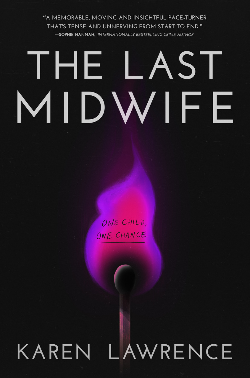
I envisaged a story contrasting a highly medicalised and coercive hospital with an outlawed midwife living and working on a canal boat. In my imagined world, England has a One Child Policy, with c-section births and female sterilisation enforced by a government seeking to restrict reproduction to the wealthy and ‘suitable’. With the near-total medicalisation of birth, women lack the means or the confidence to birth outside the system. This became the setting for my bestselling dystopian novel, The Last Midwife.

“In achieving the depersonalisation of childbirth and at the same time solving the problem of pain, our society may have lost more than it has gained. We are left with the physical husk; the transcending significance has been drained away. In doing so, we have reached the goal which is perhaps implicit in all highly developed technological cultures, mechanised control of the human body and the complete obliteration of all disturbing sensation.” – Sheila Kitzinger, Women as Mothers
Giving birth is an intensely human and meaningful act. We feel instinctively that the birth of a child should not be – cannot be – something that is done to a woman; it is the mother’s own free act of self-giving. Babies are not ‘delivered’ by health professionals; they are birthed by women.
Highly-medicalised obstetric systems often undermine the personal and spiritual values of childbirth. If a woman feels that she is being ordered, controlled, and ‘done to’ during her birth experience, this can have a serious and lasting impact. Numerous studies show that high rates of intervention have a negative effect on maternal-infant bonding and the early release of maternal oxytocin. To birth well, a woman must feel that she is acting freely and owning her experience.
So, what does it mean for a woman to be ‘sovereign’ as she carries and births her child? ‘Sovereignty of the body’ is a concept open to interpretation. At its most radical, it can be understood as an unlimited licence to seek one’s own needs and desires, regardless of the impact on others. “It is to be beholden to no one but yourself,” declares writer Rachel W Cole, author of “The Body Sovereignty Workbook”. This sounds attractive, but in practice I think we are all, inevitably, beholden to one another. All my choices will have some impact on other people, other women, for better or worse, and their choices will affect me too.
We need an understanding of sovereignty big enough to encompass the humanity and spirituality of birth. As a person of faith, I find this in the ‘Theology of the Body’ developed by Pope St John Paul II.1 This is a moral and philosophical basis for human life and relationships grounded in the intrinsic freedom of each individual:
“The incommunicable, the inalienable, in a person is intrinsic to that person’s inner self, to the power of self-determination, free will. No one else can want for me. No one can substitute his or her act of will for mine. … I am, and I must be, independent in my actions.” – Pope St John Paul II – Love and Responsibility
John Paul II goes on to argue that human love and society must be founded on each person’s capacity freely to give him or herself to another in love. The person remains sovereign over her own choices, but the purpose of that sovereignty extends beyond isolated self-determination. Its purpose is love, and love is what makes us human.
A birthing woman is in the process of becoming a mother; she is bringing a new life into the world. I struggle to think of a more perfect act of self-giving love. And so, of course, she must be free and sovereign, the undisputed queen of her birthing space.
And, just as every true queen has attendants to attest to her status and meet her needs, so the birthing mother should have acolytes, ladies-in-waiting, midwives. In a world where women rightly fear coercion and a cascade of interventions, I understand and sympathise with the trend for ‘freebirth’; the term itself sounds attractive. But I am not ready to let go of the proper role of the midwife – a role to which I aspired, even while I often failed to achieve it – because I believe that we all need one another, and a true midwife has unique skills to offer.
When I worked on the labour ward, we did our best to mouth the language of ‘choice’, asking a perfunctory permission before vaginal examination or other invasive techniques. But saying, “is it all right if I …” while hinting at dire consequences should the woman refuse, scarcely facilitates genuinely free decisions.
A birthing woman needs more than empty options; and she needs more than to be left alone. It is all very well to have the right of self-determination, but women need respectful support too, not only during pregnancy and birth, but throughout the whole experience of child-rearing. As the adage goes, “It takes a village to raise a child,” and this has never been more true than in our fragmented, western society.
In The Last Midwife, the state employs the terminology of “choice” to direct women to an ever-narrowing menu of hollow options. But the outlawed midwives risk everything to help vulnerable women birth with respect, holistic support, and love.
In this scene, midwife Liz and her student Chiara are present at a birth where the mother is truly sovereign:
“Liz crouches beside Devorah, and takes her face in her hands.
‘My love,’ she tells her, ‘your baby is nearly here. Don’t be afraid. You are more powerful than you know, and women like you, your mothers and grandmothers, have been doing this for thousands of years. Can you get up off the bed?’
Devorah places one foot onto the floor, then the other. As she stands, Chiara hears a soft splash, and a sweet, almond smell rises from the clear liquid flowing down Devorah’s legs. Gaskin mews and leaps onto a shelf. Chiara’s clothes are splattered with the waters.
‘Sorry,’ says Liz, passing Chiara a towel. ‘I should’ve given you an apron; occupational hazard, getting wet.’ She checks the baby’s heartbeat again, then, satisfied, encourages Devorah to walk up and down the length of the boat. Devorah soon finds her rhythm, pacing intently, pausing to make low, grunting sounds with every surge. Between the contractions, she repeats something under her breath in a language Chiara doesn’t know.
A brass rail runs the length of the kitchen surface. After half an hour of pacing, Devorah stops. She grabs the rail with both hands and drops into a deep squat, groaning more loudly than ever. What if someone hears? Chiara tries shushing her but Liz waves a dismissive hand.
‘No stopping her now. She’s got a universe to deliver, haven’t you, my love? Go with it, Devorah.’
Devorah’s shouts rise in a crescendo. She might be in agony or ecstasy; it would sound the same. She lowers a hand to the space between her legs. Her face is pure focus.
‘He’s coming,’ she cries. Her whole body bears down. She bellows like a creature in a stable. She yells. And now there is a head: a wet, shining head rising up where before there was darkness. Liz shines a torch and at first Chiara can only see a purple dome. As she watches, the baby’s face emerges. Devorah pulls herself upright and the whole baby tumbles from her. Liz catches him in her arms, gathering him into a warmed towel. He opens his mouth, throws back his head, and cries.
Liz dries the child and hands him to his mother, settling Devorah onto a heap of cushions. She helps Devorah loosen her nightgown and nestles the rosy baby between his mother’s breasts. He quietens and begins to turn his head from side to side.
‘Looking for his dinner already,’ says Liz. ‘Or is it breakfast? Congratulations, beautiful Mamma. You did it!’” – The Last Midwife
Liz is the midwife I wish I could have been. Let’s all do what we can to work together to enable every woman to birth in true freedom, queen of her family, and surrounded by love.
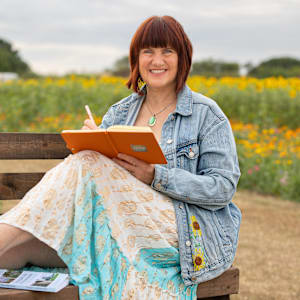
Author Bio: Karen Lawrence is a mother and grandmother, living in Billericay, Essex. She has seven grown-up children and two grandchildren (so far).
Karen started writing during the Covid pandemic and hasn’t stopped. Her bestselling novel, The Last Midwife, was published in 2025. She has also written a book about finding calm, a memoir about having a child with Down syndrome, and the story of her walking pilgrimage to Walsingham. She is currently working on the sequel to The Last Midwife. When she isn’t writing, Karen loves walking, swimming in the sea, and relaxing at the family caravan in Suffolk. Karen has three degrees in English Literature, including a PhD on Religious Faith in the Victorian Novel.
Karen previously trained and worked as a midwife in the NHS. After leaving this role she became a health visitor, pregnancy yoga teacher and antenatal instructor. She remains passionate about empowering women to have life-enhancing birth experiences.
https://karenlawrenceauthor.com/ https://karenlawrenceauthor.com/
1 Pope John Paul II (1997) The Theology of the Body: Love in the Divine Plan. Alba House, U.S.
The AIMS Journal spearheads discussions about change and development in the maternity services.
AIMS Journal articles on the website go back to 1960, offering an important historical record of maternity issues over the past 60 years. Please check the date of the article because the situation that it discusses may have changed since it was published. We are also very aware that the language used in many articles may not be the language that AIMS would use today.
To contact the editors, please email: journal@aims.org.uk
We make the AIMS Journal freely available so that as many people as possible can benefit from the articles. If you found this article interesting please consider supporting us by becoming an AIMS member or making a donation. We are a small charity that accepts no commercial sponsorship, in order to preserve our reputation for providing impartial, evidence-based information.
AIMS supports all maternity service users to navigate the system as it exists, and campaigns for a system which truly meets the needs of all.