
AIMS Journal, 2026, Vol 38, No 2
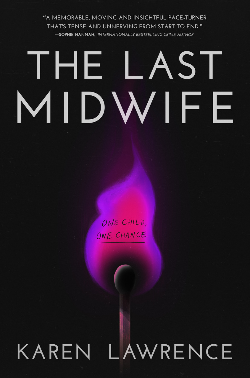
By Karen Lawrence
Published by Exodus Books on 25th November 2025
474 pages
ISBN-10 : 1919376402
ISBN-13 : 978-1919376400
Available to buy for £13.99 from Amazon.
Reviewed by Katherine Revell
In ‘The Last Midwife’, Karen Lawrence uses the power of story telling to hold up a mirror to the current state of our maternity system and the direction it is heading. She creates a dystopian world, a world of extremes, where the rich live in plush apartments in the gated city of London, and the poor live in squalid camps in the marshes. As in all hierarchical societies, it is the women who are most oppressed. They are obliged to wear ‘fem bands’ – electronic wrist bands, colour coded to denote their status – red for fertile (or ‘filly’), blue for pregnant (or ‘incubating’) and gold for sterile (or ‘sealed’). Sterilisation is actively encouraged and rewarded with perks such as job promotion, and is obligatory after birth in order to comply with the population mandates.
The Genesis Centre, with its shiny marble floors and high ceilings, bland piped music and artificial flower smells, is a high-tech, state-of-the-art women’s maternity hospital, which prides itself on its safety record. All babies (or neonates) are delivered by caesarean and if an occasional ‘normal’ birth starts to happen, it is seen as an emergency, from which the terrified woman is rescued and then is “tearful with gratitude” at having been spared the “horrors of childbirth”.
In this world, midwives are outlawed and are being arrested and interrogated. They are seen as witches and their skills and knowledge deemed barbaric, medieval and dangerous. However, as in all authoritarian societies, there is an underground network of resistance. An ever-diminishing number of midwives still operate, in secret, serving the community and doing what midwives have always done: helping women birth their babies.
Three women’s lives become intertwined as the story unfolds. Chiara is a nurse from Sicily who comes to work at the Genesis Centre, and soon discovers the sinister goings-on behind the glossy exterior; Rava is pregnant and married to an ambitious government official, Martin, who is making his reputation on rounding up the midwives; and Liz is a midwife, living on a canal boat outside the city gates, with a cat called ‘Gaskin’.
The contrast between the two birthing environments couldn’t be starker. Here is a visceral description of a caesarean birth at the Genesis Centre:
“The lights glare white overhead. After the skin comes yellow fat, then fascia, then muscle. The surgeon opens Katie like a parcel, layer by layer, looking for the treasure inside. Little wafts of smoke spiral upwards as he cauterises the blood vessels. It smells like barbecued meat.”
The new mothers are heavily sedated and bewildered by their babies:
“They have won the childbearing lottery but don’t know what to do with their prize”.
By contrast, in the womb-like interior of the ‘Rosie Lee,’ Liz’s houseboat, a young mother, Zoe, “sways and gyrates her hips in the birth dance of a thousand generations,” and another mother after the birth of her baby, “feels a stab of love, pure and intense. She would die for this child.”
It is the normalising of the horrors that take place behind the scenes at the Genesis Centre that is so shocking. At the sinister ‘Neonatal 2’ ward, a bored young nurse mindlessly scrolls through her social media feed while in charge of the babies who are being starved to death. When Chiara enters, she looks up and says, “Milk or meds?” and casually talks about babies who have been “signed off as no feeds.”
Chiara joins the resistance and gradually learns from Liz how to be a midwife. And we learn with her. Midwifery knowledge is sprinkled throughout the book. We learn about herbs: calendula and comfrey balm for bruises and swelling; honey apple and spices as an energy elixir; peppermint infusion to encourage passing water; lavender to prevent panic; nettle and fenugreek to boost milk production; shepherd’s purse tincture to intensify contractions; valerian for sleep; eyebright for coughs and colds. We learn about techniques: ‘shaking the apple tree’, using a scarf to encourage the baby to turn; ‘closing the bones’ with massage and binding after birth; listening to a baby’s heart beat through a pinard – to Chiara, hearing it for the first time, it sounds like “an intimate whisper, a secret message, a call to prayer.”
Liz has some pearls of wisdom to offer Chiara:
“Modesty is important. You need to think about each woman’s background and beliefs, what makes her feel at home. She won’t be able to let go otherwise,” and “Pay proper attention, watch the signs, and most healthy breech babies will birth themselves”.
Chiara grows in courage as she grows in knowledge and experience. She begins to find her voice:
“Safe! All I ever hear in this country is safe. Where is the point in safe if you die inside yourself? How can you ever be safe, unless first you are free?”
The Last Midwife is a beautifully written, gripping, fast-paced story, with lots of twists and turns. (It is also hilarious in places – “Is that incubator chest-feeding?” asks the horrified Sister Miller.) The book not only shines a light upon our own fear-based maternity system, but it is also a call to action. I’ll leave the last word to Liz:
“We can’t win every battle, but we don’t quit either. Midwives are warriors. We don’t give up. We don’t bow to the powers that be. Women and their babies rely on us – you might say life depends on us. So we keep fighting - warriors till our last breath.”
Reviewer Bio: Katherine Revell became passionate about childbirth when pregnant for the first time, back in 1994. Her first homebirth was a deeply empowering experience, and led her to train and work as an active birth teacher and doula, which she did for over twenty years. She no longer works in the birthing world, but keeps her passion alive by working as a Helpline Volunteer for AIMS. Please visit ninjagranny.org to find out more about Katherine's work as a Tai chi, Qigong and Somatics teacher.
The AIMS Journal spearheads discussions about change and development in the maternity services.
AIMS Journal articles on the website go back to 1960, offering an important historical record of maternity issues over the past 60 years. Please check the date of the article because the situation that it discusses may have changed since it was published. We are also very aware that the language used in many articles may not be the language that AIMS would use today.
To contact the editors, please email: journal@aims.org.uk
We make the AIMS Journal freely available so that as many people as possible can benefit from the articles. If you found this article interesting please consider supporting us by becoming an AIMS member or making a donation. We are a small charity that accepts no commercial sponsorship, in order to preserve our reputation for providing impartial, evidence-based information.
AIMS supports all maternity service users to navigate the system as it exists, and campaigns for a system which truly meets the needs of all.